Herding the Nerds

chuck.jpg

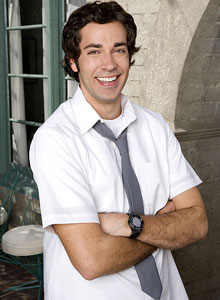
This cheerful fellow is Chuck Bartowski (Zachary Levi), the lead character on NBC’s new series Chuck. Notable not just for its privileged placement as the lead-in to Heroes on Monday nights, Chuck stands out to me as a particularly significant shift in how primetime network TV audiences are conceptualized and spoken to — or to use a fancy but endlessly useful term from Louis Althusser’s work, interpellated. Like Heroes, Chuck offers viewers a user-friendly form of complex, mildly fantastical narrative: call it science-fiction lite, albeit several shades “liter” than Heroes‘s chase-structured saga of anxious, insecure superheroes or Lost‘s island of brooding mindgamers. In fact, as I think back over the family tree from which Chuck seems to have sprouted, I detect a steady march toward the innocuous: consider the progression from Twin Peaks to The X-Files to Buffy: The Vampire Slayer to Lost and its current offspring. Dark stuff, yes, but delivered in ever more buoyantly funny and sexy packages. (Only Battlestar Galactica seems determined to honor its essentially traumatic and decentering premise.)

But maybe I’m putting Chuck in the wrong box. The show is a cross between Alias and Ed, with a little sprinkle of Moonlighting and a generous glaze of rapid, self-conscious dialogue in the style of Gilmore Girls and Grey’s Anatomy. The main character works at a big electronics chain (think The 40-Year-Old Virgin, though here the brand milieu has not even been disguised to the degree it was in that movie — Chuck is a member of the “Nerd Herd,” a smug shoutout to the corporately-manufactured tech cred of Best Buy’s Geek Squad). The conceit on which the show gambles the audience’s disbelief is that Chuck has acquired a vast trove of classified “intel” through exposure to an image-filled email (think the cursed videotape of The Ring crossed with the brainwashing montage of The Parallax View) and now finds himself at the intersecting foci of several large, conspiratorial, deadly government organizations. Not a setup that necessarily oozes laughs and romance. But laughs and romance is what, in this case, we get. Like Levi’s unassuming good looks, Chuck‘s puppydog appeal seems destined to win over audiences — though handicapping shows this early is a fool’s game.

Monday’s pilot episode efficiently established that Chuck will be aided in his navigation of the dangers ahead not just by a beautiful female secret agent (Yvonne Strahovski), but his nebbishly sidekick at “Buy More.” In case we were skeptical of Chuck’s pedigree as a leading man, that is, the scenario helpfully supplies a socially-stunted homunculus in the form of his buddy Morgan Grimes (Joshua Gomez), shifting the burden of comic relief from Chuck and thereby moving him a crucial rung up the status ladder. While Chuck responds to his sudden aquisition of epistemological ordnance with deer-in-the-headlights cluelessness, Morgan takes to the larger game right away, advising Chuck on sexual tactics and the correct way to defeat a ninja with a sureness of touch derived equally, one presumes, from excessive masturbation and too many hours playing Splinter Cell and Metal Gear Solid.

What impresses me is that Chuck not only gives us a scenario geared toward geek fetishes, but embeds within itself a passel of geeks as decoding agents and centers of action. In this regard, it’s something like a virtual-reality program running on Star Trek‘s holodeck: a choose-your-own-adventure game whose ideological lure consists of nakedly mirroring its player/viewer in the form of a central character who is not, at least at first glance, a fantasy ideal, a performative mask, a second skin. It impresses me, but also alarms me. It is a storytelling tactic that all too serendipitously echoes the larger strategies of that most expert and ephemeral of modern commodities, the TV serial, which seeks to win from us one simple thing: our ongoing commitment. Chuck acknowledges that its audience is made up of prefab fans, eager for new affiliations, no matter how machine-lathed and focus-group-tested those engines of imaginary engagement may be. (In fact, it congratulates the audience for “getting” its nested inside jokes, chief among which is the fact of their own commodification; the ideal viewer of Chuck is precisely the illegal torrenter of media that NBC hopes to convert with its downloadable content.) Plotwise, with what I’m confident will be a spiraling shell-game of reveals and cliffhangers building toward some season-ending epiphany, Chuck will surely feed the jouissance of genre-based prediction and diegetic decryption that Tim Burke has labelled “nerd hermeneutics.”

I may or may not watch Chuck, depending on my taste for my own taste for cotton candy. By comparison, Heroes, which opened its second season on Monday night, was reassuringly byzantine and willing to frustrate. Perhaps that’s the value of new TV shows, which seem so offputtingly transparent in the way they play on our pleasures — revealing to us how easily we are taken in (and taken aboard), again and again. New shows come along and retroactively establish the authenticity of their predecessors, just as Chuck, measured against next year’s new offerings, will surely ripen from empty copy to cherished original.
NBC’s Heroic Measures

heroes_title_card.png

Though I’m sure spoilerrific information is out there — perhaps in the fall previewing going on at The Extratextuals, which I look forward to reading starting tomorrow — I’m as pure as the driven snow when it comes to tonight’s season premiere of Heroes. I’m something of a late adopter of this show, having dived into the series a third of a way through its first season. (I still remember the blissful November weekend I spent binging on the first six episodes.) Now, like much of the country, I’m feeling the crazy wound-up energy of settling in for a great roller coaster ride. I love being in the midst of an ongoing, expertly told story which is also a game of expectations: the audience saying Yeah, but can you top yourself? and the show saying (literally) Just watch me.

So I’m glad I know nothing of what’s going to happen on a narrative level. On the industrial side, I’m equally unsure. NBC’s decision to yank its programming from iTunes struck me as remarkably stupid, especially as I imagine that the Heroes audience trends toward (A) those who will happily pay $1.99 to download episodes and (B) those who will equally happily acquire the content through torrents, peer-to-peer, or other means if the first source dries up. (Acting out the teleplays with hand-puppets, perhaps?) But at the same time, I work on a daily basis with a very devoted sector of the Heroes demographic — college students — who, I learned while teaching a course on television and new media last spring, don’t particularly mind watching their TV on network websites like NBC’s. They even stick around for the embedded advertising, which is what drives me away from such options. Maybe these young men and women lack the grouchy hacker-derived ethic which still grumbles in my guts that Information should be free … of excessive branding. Whatever the reason for these students’ easy acceptance of NBC’s proprietary flow, I applaud them for it. Whatever gets you the TV you want to see.

So NBC’s gamble of offering episodes as free downloads with a one-week expiration date may work out after all. Me, I’ll be watching tonight’s Heroes the old-fashioned way: on tape, timeshifted by an hour so my wife can catch the premiere of The Bachelor.

On Fanification

A recent conversation on gender and fandom hosted at Henry Jenkins’s blog prompted me to hold forth on the “fanification” of current media — that is, my perception that mainstream television and movies are displaying ever more cultlike and niche-y tendencies even as they remain giant corporate juggernauts. Nothing particularly earthshaking in this claim; after all, the bifurcation and multiplication of TV channels in search of ever more specialized audiences is something that’ s been with us since the hydra of cable lifted its many heads from the sea to do battle with the Big Three networks.

My point is that, after thirty-odd years of this endless subdivision and ramification, texts themselves are evolving to meet and fulfill the kinds of investments and proficiencies that — once upon a time — only the obsessive devotees of Star Trek and soap operas possessed. The robustness and internal density of serialized texts, whether in small-screen installments of Lost or big-screen chapters of Pirates of the Caribbean, anticipates the kind of scrutiny, dissection, and alternate-path-exploring appropriate to what Lizbeth Goodman has called “replay culture.” More troublingly, these textual attributes hide the mass-produced and -marketed commodity behind the artificially-generated underdog status of the cult object: in a kind of adaptive mimicry, the center pretends that it is the fringe. And audiences, without knowing they are doing so, complete the ideological circuit by acting as fans, even though the very notion of “fan” becomes insupportable once it achieves mainstream status. (In other words, to quote The Incredibles, if everyone’s a fan, then no one is.)

As evidence of the fanification of mainstream media, one need look no further than Alessandra Stanley’s piece in this Sunday’s New York Times. In her lead essay for a special section previewing the upcoming fall TV season, Stanley writes of numerous ways in which today’s TV viewer behaves, for all intents and purposes, like the renegade fans of yore — mapping, again, a minority onto a majority. Here are a few quotes:

… Viewers have become proprietary about their choices. Alliances are formed, and so are antipathies. Snobbery takes root. Preferences turn totemic. The mass audience splintered long ago; now viewers are divided into tribes with their own rituals and rites of passage.

A favorite show is a tip-off to personality, taste and sophistication the way music was before it became virtually free and consumed as much by individual song as artist. Dramas have become more complicated; many of the best are serialized and require time and sequential viewing. If anything, television has become closer to literature, inspiring something similar to those fellowships that form over which authors people say they would take to the proverbial desert island.

In this Balkanized media landscape, viewers seek and jealously guard their discoveries wherever they can find them.

Before the Internet, iPhones and flash drives, people jousted over who was into the Pixies when they were still a garage band or who could most lengthily argue the merits of Oasis versus Blur. Now, for all but hardcore rock aficionados, one-upmanship is more likely to center around a television series.

Stanley concludes her essay by suggesting that to not be a fan is to risk social censure — a striking inversion of the cultural coordinates by which geekiness was once measured (and, according to the values of the time, censured). “People who ignore [TV’s] pools and eddies of excellence do so at their own peril,” Stanley writes. “They are missing out on the main topic of conversation at their own table.” Her points are valid. I just wish they came with a little more sense of irony and even alarm. For me, fandom has always been about finding something authentic and wonderful amid the dross. Fandom is, among other things, a kind of reducing valve, a filter for what’s personal and exciting and offbeat. If mass media succeeds in de-massing itself, what alternative — what outside — is left?

Britney and Bush: The Comeback Kids

bush.jpgbritney.jpg


Last week saw an astonishing play of parallels across our media screens – a twinned spectacle of attempted resurrection which, while occupying two very different sets of cultural coordinates, were perhaps not so distinct when examined closely. If it’s true that the personal is the political, then the popular must be political too; and it’s no great stretch to say that, in contemporary media culture as well as contemporary politics, the rituals of rejuvenation are more alike than dissimilar.

Britney Spears’s opening number at the MTV Video Music Awards on September 9 has by now been thoroughly masticated and absorbed by the fast-moving digestive system of blogosphere critics, with TMZ and Perez Hilton leading the way. I won’t belabor Britney’s performance here, except to note that when I, like much of the nation, succeeded in finding online video documentation the next day despite the best efforts of MTV and Viacom, it was just as fascinatingly surreal (or surreally fascinating) to watch as promised: a case where the hype, insofar as it was a product of derision rather than promotion, accurately described the event.

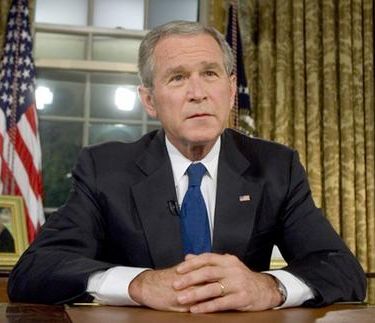
The other performance last week was, of course, George W. Bush’s September 13 address to the nation discussing the testimony of General David Petraeus before Congress. Again, there is little point in rehearsing here what Petraeus had to say about Iraq, or what Bush took away from it. For weeks, the mainstream media had been cynically predicting that nothing in the President’s position would change, and when nothing did, the outraged responses were as strangely, soporifically comforting as anything on A Prairie Home Companion. The jagged edges of our disillusion have long since been worn to the gentle contour of rosary beads, the dissonance of our angry voices merged into the sweet anonymous harmony of a mass chorus (or requiem).

What stands out to me is the perfect structural symmetry between Britney and Bush’s public offering, not of themselves – I’m too much a fan of Jean Baudrillard to suppose there is any longer a “there” there, that the individual corporeal truths of Britney and Bush did not long ago transubstantiate into the empty cartoon of the hyperreal – but of their acts. Both were lip-synching (one literally, one figuratively), and if Bush’s mouth matched the prerecorded lyrics more closely than did Britney’s, I can only ascribe it to his many more years of practice. I’ve always considered him not so much a man as a mechanism, a vibrating baffle like you’d find in a stereo speaker, emitting whatever modulated frequencies of conservative power and petroleum capital he was wired to. Unlike his father or the avatars of evil (Rove, Cheney, Rumsfeld) that surround him, Bush has never struck me as sentient or even, really, alive – he gives off the eerie sense of a ventriloquist’s dummy or a chess-playing robot. (Admittedly, he did at the height of his post-9/11 potency manifest another mode, the petulant child with unlimited power, like Billy Mumy’s creepy kid in the Twilight Zone episode “It’s a Good Life.”)

Britney, by contrast, seems much less in synch with the soundtrack of her life, which is what makes her so hypnotically sad and wonderfully watchable. I flinch away when words emanate from Bush the way I flinch when the storm of bats flies out of the cave early in Raiders of the Lost Ark; Britney’s clumsy clomping and uncertain smile at the VMAs is more like a series of crime-scene photos, slow-motion film of car wrecks, or the collapsing towers of the World Trade Center. Like any genuine trauma footage, you can’t take your eyes off it.

Where Britney and Bush came together last week was in their touching allegiance to strategies that worked for them in the past: hitting their marks before the cameras and microphones, they struck the poses and mouthed the words that once charmed and convinced, terrified and titillated. The magic has long since fled – you can’t catch lightning in a bottle twice, whether in the form of a terrorist attack or a python around the shoulders – but you can give it the old college try, and even if we’re repulsed, we’re impressed. But is it stamina or something more coldly automatic? Do we praise the gear for turning, the guillotine blade for dropping, the car bomb for exploding?

Game Studies Position at IU

I was excited to see that my former academic home base, the Department of Communication and Culture at Indiana University in Bloomington, is searching for a faculty hire in game studies. Here’s the job description:

Assistant Professor in Digital Media Studies


The Department of Communication and Culture at Indiana University invites applications for a tenure-track assistant professor position in digital media studies to begin Fall 2008. We seek an individual with expertise in critical approaches to digital media to join an innovative, interdisciplinary program that includes media studies, ethnography and performance studies, and rhetoric and public culture. While we invite candidates from a wide range of disciplinary backgrounds, we encourage applicants involved in research on the cultural, political, and communicative aspects of online games and in the broader field of digital game studies. Research may involve the formal qualities of digital games, their social and political dimensions, as well as questions of genre, narrative, and history. Applicants should be prepared to discuss the role that digital media play in shaping perceptions of history and culture, in forging individual and collective identities, and in mediating social change. Applicants are expected to have a strong research agenda and a commitment to excellence in teaching. Preference will be given to candidates who have their Ph.D. in hand by the date of appointment. Applicants should send a letter of application, curriculum vitae, writing sample, and three letters of recommendation. Review of applications will begin on November 16, 2007. Address applications to: Christopher Anderson, Chair, Digital Media Studies Search, Department of Communication and Culture, 800 East Third St., Indiana University, Bloomington IN 47405.


This is great news, not just because Bloomington’s a wonderful town (I lived there for six years), but because CMCL is a fantastic department, full of energetic and friendly scholars at both the graduate and faculty level. In recent years they’ve hired several young and exciting academics, including Phaedra Pezzullo, Ted Striphas, Mary L. Gray, and Josh Malitsky, all of whom do imaginative, politically engaged, boundary-crossing research. Meanwhile, the department has drawn M.A. and Ph.D. students in ever greater numbers who are planted firmly in the fast lane of digital and new media studies. Perhaps the best thing about CMCL, though, is that it also honors the disciplines of traditional film and media studies as well as rhetoric and pedagogy, making for a truly rich and interdisciplinary environment. I recommend the job, the department, the university, and the town to all interested applicants.