Digital Day for Night

A quick followup to my recent post on the new Indiana Jones movie: I’ve seen it, and find myself agreeing with those who call it an enjoyable if silly film. Actually, it was the best couple of hours I’ve spent in a movie theater on a Saturday afternoon in quite a while, and seemed especially well suited to that particular timeframe: an old-fashioned matinee experience, a slightly cheaper ticket to enjoy something less than classic Hollywood art. Pulp at a bargain price.

But my interest in the disproportionately angry fan response to the movie continues. And to judge by articles popping up online, Indiana Jones and the Kingdom of the Crystal Skull is providing us, alongside its various pleasures (or lack thereof), a platform for thinking about that (ironically) age-old question, “How are movies changing?” — also known as “Where has the magic gone?” Here, for example, are three articles, one from Reuters, one from The Atlantic.com, and one from an MTV blog, each addressing the film’s heavy use of CGI.

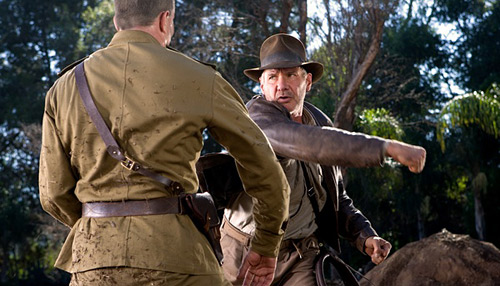
I can see what they’re talking about, and I suppose if I were less casual in my fandom of the first three Indy movies, I’d be similarly livid. (I still can’t abide what’s been done to Star Wars.) At the same time, I suspect our cultural allergy to digital visual effects is a fleeting phenomenon — our collective eyes adjusting themselves to a new form of light. Some of the sequences in Crystal Skull, particularly those in the last half of the film, simply wouldn’t be possible without digital visual FX. CG’s ability to create large populations of swarming entities onscreen (as in the ant attack) or to stitch together complex virtual environments with real performers (as in the Peru jungle chase) were clearly factors in the very conception of the movie, with the many iterations of the troubled screenplay passing spectacular “beats” back and forth like hot potatoes on the assumption that, should all else fail, at least the movie would feature some killer action.

Call it digital day for night, the latest version of the practice by which scenes shot in daylight “pass” for nighttime cinematography. It’s a workaround, a cheat, like all visual effects, in some sense nothing more than an upgraded cousin of the rear-projected backgrounds showing characters at seaside when they’re really sitting on a blanket on a soundstage. It’s the hallmark of an emerging mode of production, one that’s swiftly becoming the new standard. And our resistance to it is precisely the moment of enshrining a passing mode of production, one that used to seem “natural” (for all its own undeniable artificiality). By such means are movies made, but it’s also the way that the past itself is manufactured, memory and nostagia forged through an ongoing dialectic of transparency and opacity that haunts our recreational technologies.

We’ll get used to the new way of doing things. And someday, movies that really do eschew CG in favor of older FX methodologies, as Spielberg and co. initially promised to do, will seem as odd in their way as performances of classical music that insist on using authentic instruments from the time. For the moment, we’re suspended between one mode of production and another, truly at home in neither, able only to look unhappily from one bank to another as the waterfall of progress carries us ever onward.

Indiana Jones and the Unattainable FX Past

This isn’t a review, as I haven’t yet made it to the theater to see Indiana Jones and the Kingdom of the Crystal Skull (portal to the transmedia world of Dr. Jones here; typically focused and informative Wiki entry here). What I have been doing — breaking my normal rule about keeping spoiler-free — is poring over fan commentaries on the new movie, swimming within the cometary aura of its street-level paratexts, working my way into the core theatrical experience from the outside in. This wasn’t anything intentional, more the crumbling of an internet wall that sprang one informational leak after another, until finally the wave of words washed over me like, well, one of the death traps in an Indiana Jones movie.

Usually I’m loath to take this approach, finding the twists and turns of, say, Battlestar Galactica and Lost far more compelling when they clobber me unexpectedly (and let me add, both shows have been rocking out hard with their last couple of episodes). But it seemed like the right approach here. Over the years, the whole concept of Indiana Jones has become a diffuse map, gas rather than solid, ocean rather than island. Indy 4 is a media object whose very essence — its cultural significance as well as its literal signification, the decoding of its concatenated signage — depends on impacted, recursive, almost inbred layers of cinematic history.

On one level, the codes and conventions of pulp adventure genres, 1930s serials and their ilk, have been structured into the series film by film, much like the rampant borrowings of the Star Wars texts (also masterminded by George Lucas, whose magpie appropriations of predecessor art are cannily and shamelessly redressed, in his techno-auteur house style, as timelessly mythic resonance). But by now, 27 years after the release of Raiders of the Lost Ark, the Indy series must contend with a second level of history: its own. The logic of pop-culture migration has given way to the logic of the sequel chain, the franchise network, the transmedia system; we assess each new installment by comparing it not to “outside” films and novels but to other extensions of the Indiana Jones trademark. Indy 4, in other words, cannot be read intertextually; it must be read intratextually, within the established terms of its brand. And here the franchise’s history becomes indistinguishable from our own, since it is only through the activity of audiences — our collective memory, our layered conversations, the ongoing do-si-do of celebration, critique, and comparison — that the Indy texts sustain any sense of meaning above and beyond their cold commodity form.

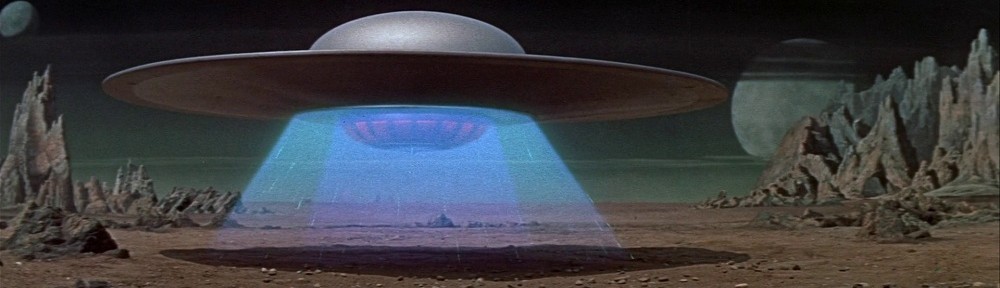
All of this is to say that there’s no way Indiana Jones and the Kingdom of the Crystal Skull could really succeed, facing as it does the impossible task of simultaneously returning to and building upon a shared and cherished moment in film history. While professional critics have received the new film with varying degrees of delight and disappointment, the talkbacks at Aint-It-Cool News (still my go-to site for rude and raucous fan discourse) are far more scornful, even outraged, in their assessment. Their chorused rejection of Indy 4 hits the predictable points: weak plotting, flimsy attempts at comic relief, and in the movie’s blunt infusion of science-fiction iconography, a generic splicing so misjudged / misplayed that the film seems to be at war with its own identity, a body rejecting a transplanted organ.

But running throughout the talkback is another, more symptomatic complaint, centering on the new film’s overuse of CG visual effects. The first three movies — Raiders, Temple of Doom, and Last Crusade — covered a span from 1981 to 1989, an era which can now be retroactively characterized as the last hurrah of pre-digital effects work. All three feature lots of practical effects — stuntwork, pyrotechnics, and the on-set “wrangling” of everything from cobras to cockroaches. But more subtly, all make use of postproduction optical effects based on non-digital methods: matte paintings, bluescreen compositing, a touch of cel animation here, a cloud tank there. Both practical and optical effects have since been augmented if not colonized outright by CG, a shift apparently unmissable in Indy 4. And that has longtime fans in an uproar, their antidigital invective targeted variously on Lucas’s influence, the loss of verisimilitude, and the growing family resemblance of one medium (film) to another (videogames):

The Alien shit didnt bother me at all, it was just soulless and empty as someone earlier said.. And the CGI made it not feel like an Indy flick in some parts.. I walked out of the theater thinking the old PC game Fate of Atlantis gave me more Indiana joy than this piece of big budget shit.

My biggest gripe? Too much FUCKING CGI. The action lacked tension in crucial places. And there were too many parts (more than from the past films) where Looney Tunes physics kept coming into play. By the end, when the characters endure 3 certain deaths, you begin to think “Okay, the filmmakers are just fucking around, lean back in your seat and take in the silliness.” No thanks. That’s not what makes Indiana Jones movies fun.

This film was AVP, The Mummy Returns and Pirates of the Fucking Carribean put together, a CGI shitfest. A long time ago in a galaxy far far away, Lucas said “A special effect is a tool, a means to telling astory, a special effect without a story is a pretty boring thing.” Take your own advice Lucas, you suck!!!

The entire movie is shot on a stage. What happened to the locations of the past? The entire movie is CG. What a disappointment. I really, REALLY wanted to enjoy it.

Interestingly, this tension seems to have been anticipated by the filmmakers, who loudly claimed that the new film would feature traditional stuntwork, with CGI used only for subtleties such as wire removal. But the slope toward new technologies of image production proves to be slippery: according to Wikipedia, CG matte paintings dominate the film, and while Steven Spielberg allegedly wanted the digital paintings to include visible brushstrokes — as a kind of retro shout-out to the FX artists of the past — the result was neither nostalgically justifiable or convincingly indexical.

Of course, I’m basing all this on a flimsy foundation: Wiki entries, the grousing of a vocal subcommunity of fans, and a movie I haven’t even watched yet. I’m sure I will get out to see Indy 4 soon, but this expedition into the jungle of paratexts has definitely diluted my enthusiasm somewhat. I’ll encounter the new movie all too conscious of how “new” and “old” — those basic, seemingly obvious temporal coordinates — exceed our ability to construct and control them, no matter how hard the filmmakers may try, no matter how hard we audiences may hope.
A Marvel of Engineering

The opening act of the summer movie season, Iron Man, is much like the machine armor worn by Tony Stark (Robert Downey Jr.): a potent blend of advanced technology, sleek style, and glowing energy. The fetishism of the super-suit has rarely been quite so explicitly rendered, or embraced with such pornographic shamelessness, in comic-book cinema. Sure, movies and television have given us plenty of heroes whose iconic power resides in the costume (whether caped or capeless): Christopher Reeve’s Superman, Tobey Maguire’s Spider-Man, the leather-overcoat-and-sunglasses combo of Wesley Snipes in Blade, the patriotic bustier worn by Lynda Carter as Wonder Woman. Often these sartorial choices become flashpoints of controversy with fans: think of Bryan Singer’s X-Men adaptation, which did away with the classic yellow costumes of the comic series, or the many nippled and sculpted variations of the Batsuit worn by the Batactors playing a series of Batmen in the Batfranchise.

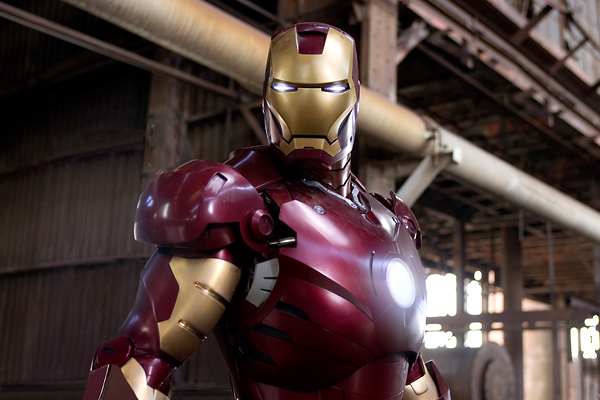
In Iron Man, the situation is different, for Iron Man is his suit, the “secret identity” within a compromised figure both morally and physically. Over the course of the story, Stark’s transformation from a hard-partying weapons magnate to a passionately peace-committed and (mostly) teetotaling cyborg is made concrete — made metal, really — through the metaphor of the successively more sophisticated armor shells in which he encases himself. The first is a kitbashed monstrosity the color of corroded tin cans, crisscrossed with scars of solder. Like a rustbucket car, it survives just long enough to convey Stark to version two, a more compact silver exoskeleton reminiscent of Ginsu knives and Brookstone gadgets. It’s quite satisfying when Stark arrives at the canonical configuration, a red-and-gold chassis of interlocking plates, purring hydraulics, and HUD graphics that answers the question “What would it be like to wear a Lamborghini?”

What’s clever is how these upgrades express Stark’s ethical evolution while recapitulating decades of shifting design in the Marvel comic series from which this movie sprang. (It’s kind of like a He’s Not There version of James Bond in which the lead is played over the course of the film by Sean Connery, then Roger Moore, followed by Timothy Dalton, Pierce Brosnan, and Daniel Craig — with a quick dream interlude, of course, starring George Lazenby.) Iron Man, in other words, manages to honor superhero history rather than pillaging it, and this — along with the film’s smart screenplay and glossy digital mise-en-scene — wins it a sure place in future best-of lists when it comes to the spotty genre of comic-book adaptations.

Another weapon in the film’s arsenal, riding within in its narrative delivery system like he pilots his mechanical costume, is Robert Downey Jr., who seems to have arrived at a point of perfect intertextual harmony with this turn in his career. His performance as Stark is properly lived-in and mischievous (indeed, the actor’s persona is yet another kind of suit, this one built of bad publicity) yet alive with disarmingly sincere warmth. In one of the film’s facile yet pitch-perfect tropes, Stark must wear a pulsing blue-and-white generator on his chest, a kind of electromagnetic pacemaker that doubles as an energy source for his armor and trebles as a signifier of the character’s humanity. Downey Jr. is himself a kind of power source that propels the vehicle of Iron Man forward while lending it, in stray moments, genuine moral weight. His portrayal reminds us that, while a superhero’s technological or organic essence is important, the larger ingredient is something harder to quantify and calibrate — in Stark’s case, a kludge of intellect, imagination, and compassion that easily trades one outfit for another.

That’s not all that’s going on under the hood: the fight scenes, not to mention flight scenes, are awesome, and Jeff Bridges is remarkably menacing with all his hair relocated from his head to his chin. There’s some nimble ideological shadowboxing around the the military-industrial complex and the terrible allure of “shock and awe” (there’s your real pornography). And while Stan Lee makes his trademarked cameo, branding this as yet another item in Marvel’s transmedia catalog, a quirky counterpoint is sounded when a villain taunts Stark by asking “Did you really think that just because you had an idea, it belongs to you?” For comic fans, it’s hard not to hear this and think of Marvel’s infamous screwing of Jack Kirby. At the same time, we should count our blessings that concepts like Iron Man travel so fluidly through our mediascape, rephrasing themselves in the transformational grammar of convergence cinema. Too often, the result is an ugly and lifeless thing — a strangled fragment like Daredevil, a run-on sentence like Van Helsing. But once in a lucky while, you get a perfect little poem like Iron Man.