
Movie-a-Day: November 2007

mist.jpg

An unexpected benefit of charting my movie-watching habits through this series of posts is the perspective it sheds on my work rhythms — the ebb and flow of teaching, grading, doing research, and attending daily to dozens of other details of the academic profession — and their impact on what I choose to watch. November was crazy-busy — not just with school but a trip back to Indiana for Thanksgiving with my and my wife’s families, followed by our first wedding anniversary. Looking back, I’m surprised that I got to see anything at all. But no: somehow I managed to squeeze in nineteen films in thirty days, or roughly (my compulsive calculator checking reveals) .63 movies per day. Reviewing the list, though, what jumps out at me is how many recent and new releases I gravitated toward: eleven of the nineteen or (more calculator-tapping) 58% of the titles are from 2006 and 2007.

So what does this mean? Maybe older films are simply more taxing; good as my favorites were — the 1939 Hunchback of Notre Dame, Powell and Pressburger’s I Know Where I’m Going!, Bogdanovich’s Paper Moon — they demanded more in the watching than did the blissful, frictionless experience of newer pleasures like The Host, No Country for Old Men, and Meet the Robinsons. When I started this regimen last summer, I was able to sit through very old, very long movies in alert immersion — taking notes, no less. Most of November’s selections I watched flat on my back, relaxing into the TV screen or the laptop balanced on my chest, and I’m embarrassed to admit that I fell asleep once or twice during movies that really demand more respectful attention: I Walked With A Zombie, The Italian Job.

Ah well. I’ve learned to stop apologizing for watching what I watch, the way I watch it. (It’s pretty much a requirement if you commit to doing media studies.) If it surprises me now to learn that I saw The Ex — recorded in brainspace only by a fugue-patch of static — I’ll just remind myself that wasted time is usually good for the soul. But I will admit that the coming summer is starting to look very good to me: a long lush season of quiet during which I can finally get back to a real movie-a-day plan, digging into film history and moving outside my comfort zones.

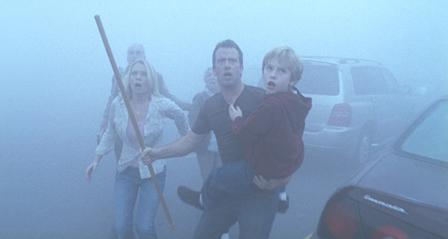
As usual, I’ve placed stars next to the films that made an unusually strong impact on me. In one case, perhaps, more stars are deserved: Frank Darabont’s adaptation of Stephen King’s The Mist was the most wrenching horror film I’ve seen since The Descent, and in its way a thing of remarkable beauty.

Movie-A-Day: November 2007

Notes On A Scandal (Richard Eyre, 2006)
The Hunchback of Notre Dame (William Dieterle, 1939)
Spider-Man 3 (Sam Raimi, 2007)
Allegro Non Troppo (Bruno Bozzetto, 1976)
Harlan County USA (Barbara Kopple, 1976)
The Italian Job (Peter Collinson, 1969)
I Know Where I’m Going! (Michael Powell & Emeric Pressburger, 1945)*
The Host (Joon-ho Bong, 2006)*
No Country for Old Men (Joel & Ethan Coen, 2007)*
Battlestar Galactica: Razor (Félix Enríquez Alcalá & Wayne Rose, 2007)
La noire de … [Black Girl] (Ousmane Sembene, 1965)
I Walked With a Zombie (Jacques Tourneur, 1943)
Sherrybaby (Laurie Collyer, 2006)*
Inland Empire (David Lynch, 2006)
The Ex (Jesse Peretz, 2006)
Meet the Robinsons (Stephen J. Anderson, 2007)
Paper Moon (Peter Bogdanovich, 1973)*
Hairspray (Adam Shankman, 2007)
The Mist (Frank Darabont, 2007)*
Retrographics and Multiplayer avant la lettre

super-mario-galaxy-21.jpg

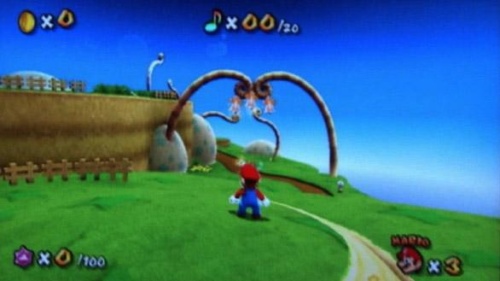
Let me start with a disclosure: although I own both a Nintendo Wii and an XBox 360, I almost exclusively play the latter — and rarely play the former. I’ve agonized over this. Why does my peak Wii moment remain the mercenary achievement of tracking one down last summer? Why haven’t the Wii-mote and its associated embodied play style inspired me to spend a fraction as many hours in front of the television as I’ve spent working through Katamari Beautiful, Valve’s Orange Box, Halo 3, and Need for Speed Carbon on the Xbox? The answer, it seems to me, comes down to graphics: Microsoft’s console simply pushes more pixels and throws more colors on my new HD TV, and I vanish into those neon geometries without looking back. I feel guilty about this, vaguely philistine, the same way I felt when I switched from Macintosh to PC. But there it is. Like Roy Neary (Richard Dreyfuss) in Close Encounters of the Third Kind, I go where the pretty lights lead me.

But that doesn’t make the phenomenon of the Wii any less fascinating, and the recent New York Times article on the top-selling console games of 2007 is compelling in its assertion that gamers are turning away from the kind of high-end techno-sublime represented by the Xbox 360 and the Playstation 3 and toward the simpler graphics and more accessible play style of the Wii. It makes sense that a dialectic would emerge in videogames between the superadvanced aesthetic and its primitive-by-comparison cousin; the binary of shiny-new and gnarly-old has structured everything from Quake‘s blend of futuristic cyborgs and medieval demons to Robert Zemeckis’s digital adaptation of the ancient Beowulf.  Anyone who’s discovered the joy of bringing old 8-bit games to life with emulators like MAME knows that the pleasure of play involves an oscillation between where we’ve been and where we’re going; between what passes for new now and what used to do so; between the sensory thrill of the state-of-the-art and the nostalgia of our first innocent encounters with the videogame medium in all its subjectivity-transforming power.

A less elaborate way of saying which is: the Wii represents through its pared-down graphics the return of a historical repressed, the enshrining of a certain simplicity that remains active at the medium’s heart, but until now has not been packaged and sold back to us with quite such panache.

The other interesting claim in the article is that the top games (World of Warcraft, Guitar Hero) are not solitary, solipsistic shooters like Bioshock and Halo, but rich social experiences — you play them with other people around, whether online or ranged around you in the dorm room. Seth Schiesel writes,

Ever since video games decamped from arcades and set up shop in the nation’s living rooms in the 1980s, they have been thought of as a pastime enjoyed mostly alone. The image of the antisocial, sunlight-deprived game geek is enshrined in the popular consciousness as deeply as any stereotype of recent decades.

The thing is, I can’t think of a time when the games I played as a child and teenager in the 1970s and 1980s weren’t social. I always consumed them with a sense of community, whether because my best friend Dan was with me, watching me play (or I watching him) and offering commentary, or because I talked about games endlessly with kids at school. Call it multiplayer avant la lettre; long before LANs and the internet made it possible to blast each other in mazes or admire each other’s avatarial stand-ins, we played our games together, making sense of them as a community — granted, a maligned subculture by the mainstream measure of high school, but a community nonetheless. As graphics get better and technologies more advanced, I hope that gamers don’t rewrite their pasts, forgetting the friendships forged in an around algorithmic culture.

CFP: Transformative Works and Cultures

I’m happy to announce a new journal on creative fan and media culture. The editors, Kristina Busse and Karen Hellekson, have kindly invited me to participate on the editorial review board; I accepted with pleasure. Over the last year, I’ve strongly reconnected to my early academic interest in fandom. My first real “read” as an academic was Henry Jenkins’s Textual Poachers, which I devoured during long afternoons in the air-conditioned sanctuary of the Chapel Hill Public Library, the summer before my first year of graduate school at the University of North Carolina in 1998. Now, ten years later, I’ve made a number of good new friends in the fan studies community and am pleased to be launching a course on Fan Culture at Swarthmore. I’m very eager to see where this exciting and innovative new publication will take us. Please pass the word along!

Transformative Works and Cultures (TWC) is a Gold Open Access international peer-reviewed journal published by the Organization for Transformative Works edited by Kristina Busse and Karen Hellekson.

TWC publishes articles about popular media, fan communities, and transformative works, broadly conceived. We invite papers on all related topics, including but not limited to fan fiction, fan vids, mashups, machinima, film, TV, anime, comic books, video games, and any and all aspects of the communities of practice that surround them. TWC’s aim is twofold: to provide a publishing outlet that welcomes fan-related topics, and to promote dialogue between the academic community and the fan community.

We encourage innovative works that situate these topics within contemporary culture via a variety of critical approaches, including but not limited to feminism, queer theory, critical race studies, political economy, ethnography, reception theory, literary criticism, film studies, and media studies. We also encourage authors to consider writing personal essays integrated with scholarship, hypertext articles, or other forms that embrace the technical possibilities of the Web and test the limits of the genre of academic writing. TWC copyrights under a Creative Commons Attribution-Noncommercial 3.0 Unported License.

Theory accepts blind peer-reviewed essays that are often interdisciplinary, with a conceptual focus and a theoretical frame that offers expansive interventions in the field of fan studies (5,000-8,000 words).

Praxis analyzes the particular, in contrast to Theory’s broader vantage. Essays are blind peer reviewed and may apply a specific theory to a formation or artifact; explicate fan practice; perform a detailed reading of a specific text; or otherwise relate transformative phenomena to social, literary, technological, and/or historical frameworks (4,000-7,000 words).

Symposium is a section of editorially reviewed concise, thematically contained short essays that provide insight into current developments and debates surrounding any topic related to fandom or transformative media and cultures (1,500-2,500 words).

Reviews offer critical summaries of items of interest in the fields of fan and media studies, including books, new journals, and Web sites. Reviews incorporate a description of the item’s content, an assessment of its likely audience, and an evaluation of its importance in a larger context (1,500–2,500 words). Review submissions undergo editorial review; submit inquiries first to review@transformativeworks.org.

TWC has rolling submissions. Contributors should submit online through the Web site (http://journal.transformativeworks.org). Inquiries may be sent to the editors (editor@transformativeworks.org).

The call for papers is available as a .pdf download sized for U.S. Letter (http://journal.transformativeworks.org/docs/twc-flyer-US-letter.pdf) or European A4 (http://journal.transformativeworks.org/docs/twc-flyer-A4.pdf). Please feel free to link, download, print, distribute, or post.