Apologies for taking a while to get around to writing about Avatar — befitting the film’s almost absurd graphical heft, the sheer surfeit of its spectacle, I decided to watch it a second time before putting my thoughts into words. In one way, this strategy was useful as a check on my initial enthusiasm; the blissful swoon of first viewing gave way, in the second, to a state resembling boredom during the movie’s more langourous stretches. (Banshee flight training, let’s just say, is not a lightning-fast process.) But in another way, waiting to write might not have been all that smart, since by now the movie has been discussed to death. Yet for all the hot air and cold type that’s been spent dissecting Avatar, the map of the dialogue still divides neatly into two camps: one insisting that Cameron’s movie is an instant classic of cinematic science fiction, a technological breakthrough and a grand adventure of visual imagination; the other grudgingly admitting that the film is pretty, but beyond that, a trite and obvious story lifted from Pocahontas and Dances With Wolves and populated, moreover, by a bland and predictable set of character-types.
I tend to be forgiving toward experiments as grand as Avatar, especially when they’ve done such a good job laying the groundwork of hopeful expectation. Indeed, as I walked into the theater last week, ripping open the plastic bag containing my 3D glasses, I remember thinking I’d already gotten my money’s worth simply by looking forward so intensely to the experience. There’s also the matter of auteurist precedent: James Cameron has built up an enormous amount of goodwill — and, dare I say it, faith — with his contributions of Terminator, Terminator 2: Judgment Day, and Aliens to the pantheon of SF greatness. (I’m also a closet fan of Battle Beyond the Stars, the derivative but fun 1980 Roger Corman production on which Cameron served as art director and contributed innovative visual effects.)
So I’m not fussed about whether Avatar‘s story is particularly deep or original. This is, to me, a case of the dancer over the dance; the important thing is not the tale, but Avatar‘s telling of it. And I’m sympathetic to the argument that in such a technically intricate production, a relatively simple narrative gearing is required to anchor audiences and lead them, as in a rail game, along a precise path through the jungle. (That said, Cameron’s first “scriptment” was apparently a much more complex and nuanced saga, and one wonders to what degree his narrative ambitions were stripped away as the humongous physical nature of the undertaking became clear.) Cameron is correctly understood as a techno-auteur of the highest order, a man who doesn’t make films so much as build them, and if he has, post-Titanic, become complicit in fanning the flames of his own worshipful publicity, we ought to take that as simply another feat of engineering — in this instance discursive rather than digital. It would hardly be the first time (I’m looking at you, Alfred Hitchcock) and is certainly better-deserved than some (I’m looking at you, George Lucas).
Did I like Avatar? Very much so — but as I indicated above, this is practically a foregone conclusion; to disavow the thing now would be tantamount to aesthetic seppuku. Of course, in the strange numismatics of fandom, hatred is just the other side of the coin from veneration, and the raging “avatolds” (as in, You just got avatold!) of 4chan may or may not realize that, love it or hate it, we’re all playing in Cameron’s world now. And what a world it is, literally! Avatar the film is something of a delivery system for Pandora the planet (OK, moon), an act of subcreation so extensive it has generated its own wiki. The detailed landscapes we see in the movie are merely the topmost layer of a topography and ecosystem fathoms deep, an enormous bank of 3D assets and encyclopedic autotextuality that, now established as a profitable pop-culture phenomenon, stands ready for extrapolation and exploration in transmedia to come. (Ironic, then, that a launching narrative so opposed to stripmining is itself destined to be mined, or in Jason Mittell’s evocative term, drilled.)
And in this sense, I suspect, we can locate a double meaning to the idea of the avatar, or tank-grown alien body driven by human operators via direct neural link. A biological vessel designed to allow visitors to explore an alien world, the story’s avatars are but metaphors for Avatar the movie, itself a technological prosthesis for viewers hungry to experience new landscapes (and for whom the exotics of Jersey Shore don’t cut it). 3D, IMAX, and great sound systems are merely sensory upgrades for our cinematic avatarialism, and as I watched the audience around me check the little glowing squares of their cell phones, my usual dismay was mitigated by the notion that, like the human characters in the movie, they were merely augmenting their immersion with floating GUIs and HUDs.
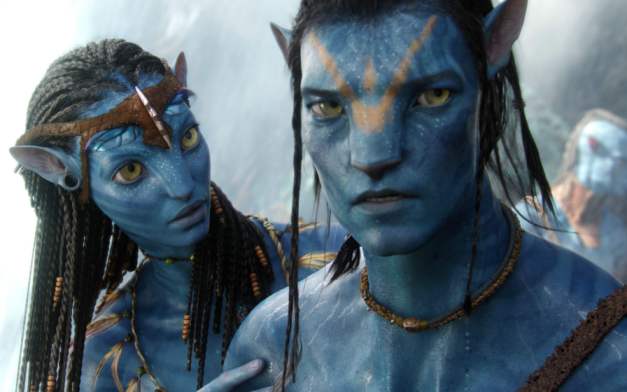
My liking for the film isn’t entirely unalloyed, and deep down I’m still wondering by what promotional magic we have collectively agreed to see Avatar as a live-action movie with substantial CG components rather than a CG animated film (a la Up, or more analogously Final Fantasy: The Spirits Within) into which human performances have cunningly been threaded. Much has been made of the motion-capture technology by which actors Sam Worthington, Zoe Saldana, Sigourney Weaver et al performed their roles into one end of a real-time rendering apparatus while Cameron peered into a computer display — essentially his own avatarial envoy to Pandora — directing his troupe through their videogame doubles. But this is merely the latest sexing-up of an “apparatus” as old as cinema, by which virtual bodies are brought to life on an animation stand, their features and vocals synched to a dialogue track (and sometimes reference footage of the original performances).
Cameron’s nifty trick, though, has always been to frame his visual and practical effects in ways that lend them a crucial layer of believability. I’m not talking about photorealism, that unreachable horizon (unreachable precisely because it’s a moving target, a fantasized attribute we hallucinate within the imaginary body of cinema: as Lacan would put it, in you more than you). I’m talking about the way he cast Arnold Schwarzenegger as the human skin around a robotic core in the Terminator films, craftily selling an actor of limited expressiveness through the conceit of a cyborg trying to pass as human; Arnold’s stilted performance, rather than a disbelief-puncturing liability, became proof of his (diegetically) mechanoid nature, and when the cutaways to stop-motion stand-ins and Stan Winston’s animatronics took over, we accepted the endoskeleton as though it had been there all along, the real star, just waiting to be discovered. An identical if hugely more expensive logic underlies the human-inhabited Nav’i of Avatar: if Jake Sully’s alien body doesn’t register as absolutely realistic and plausible, it’s OK — for as the editing constantly reminds us, we are watching a performance within a performance, Sully playing his avatar as Worthington plays Sully, Cameron and his cronies at WETA and ILM playing us in a game of high-tech Russian nesting dolls. The biggest “special effect” in Cameron’s films is the way in which diegesis and production reality collapse into each other.
I’m not saying that Avatar isn’t revolutionary, just that amid the more colorful flora and fauna of its technological garden we should be careful to note that other layer of “movie magic,” the impression of reality that is as much a discursive and ideological production as any clump of pixels pushed through a pipeline. We submit, in other words, to Avatar‘s description of itself as a step forward, an excursion into a future cinema as alien and exhilarating as anything to be found on Pandora, and that too is part of the spell the movie casts. Yet the animating spirit behind that future cinema — the ghost in the machine — remains the familiar package of hopes and beliefs we always bring to the darkened theater: the desire to escape into another body, and when the adventure is over, to wake up and go home.