

Going with the Flow

batttlestar-logo.jpg

FlowTV’s new issue is out (or, given its online nature, up): a special edition on Battlestar Galactica, guest-edited by Lynne Joyrich and Julie Levin Russo with the help of FlowTV’s editorial liaison Jean Anne Lauer. My own contribution, Downloads, Copies, and Reboots: Battlestar Galactica and the Changing Terms of TV Genre, uses Galactica’s storied evolution — its many iterations and reinventions — as a springboard for thinking about how industrial replication structures TV as well as ways of talking about TV: in particular, the emergence of terms like reboot and showrunner, which seem to me laden with implications about how TV is being reconfigured in the popular (and industrial) imaginary.

Here’s an excerpt:

Ronald D. Moore’s Battlestar Galactica is, of course, a remake or — his preferred term — “reimagining” of Glen A. Larson’s Battlestar Galactica, which ran from 1978-1979. Even in that first, Carter-era incarnation, the show occupied an undecidable space between copy and original; it was judged by many, including George Lucas and 20th Century Fox, to be a bald steal of Star Wars (1977). (Evidence of thievery was not merely textual; two of Lucas’s key behind-the-scenes talents, conceptual artist Ralph McQuarrie and visual-effects guru John Dykstra, defected to the Galactica team.) And following its first cancellation by ABC, the series was followed by the much-loathed “relaunch,” Galactica 1980, which ran just ten episodes before dying on the Nielsen vine.

The irony is not just that the 1978-1980 versions of Battlestar Galactica have now come to be seen as canonical by a subset of fans who reject Moore’s version as being GINO (“Galactica In Name Only”). Popular culture, especially from the 1950s onward, is marked by an alchemical process of nostalgia by which even the most derivative texts (Star Wars being the chief example) grow a callus of originality simply through continual shoulder-bumping with the ripoffs, sequels, and series that follow. Such is the nature of the successful media franchise, doomed to plow forward under the ever-increasing inertia of its own fecund replication.

No, what’s striking about the many iterations of Galactica is how cleanly the coordinates of its fantasy lure have flipped over time, illustrating the ability of genre myths to reconfigure themselves around new cultural priorities. Larson’s Battlestar Galactica, even in its heyday, was pure cheese, a disco-hued mélange of droning chrome robots, scrappy space cowboys, a cute mechanical dog, and endless space battles (whose repetitive nature can be attributed to the exigencies of weekly production; as with the first Star Trek, pricey optical effects were recycled to amortize their cost). Back then, it was fun to fantasize planetary diaspora as effervescent escape; the prospect of being chased from our homeworld by cyclopean robots with a mirror finish seemed, by the late seventies, as giddily implausible as Ronald Reagan moving into the White House.

But nowadays, the dream embodied in Battlestar Galactica has inverted frictionlessly into nightmare. The shift in tone is reflected in a new design scheme of drably militaristic grays and browns, brutal drumbeats on the soundtrack, and jittery camerawork on both actors and spaceships — thanks to the digital-effects house Zoic, whose signature visuals lend zoomy, handheld verisimilitude to the combat scenes. It all comes inescapably together to suggest a very different mindset: hunted, paranoid, and starkly conscious of the possibility of spiritual, if not physical, annihilation.

What I do see Battlestar Galactica bringing to the table with fresh force is the useful concept of the reboot as a strategy for dealing with franchise fatigue. A liberating alternative to the depressingly commercial and linear “sequel,” the reboot signals a profound shift in how we perceive and receive serial media. We are coming to see serial dramas as generative systems, more about ground rules and conditions of possibility than events or outcomes. (And I would argue that the only sane serial aesthetic is one that allows for occasional misfires; one bad episode does not a series invalidate.) Like the terms canon and retcon, the reboot borrows from brethren like comic books and print lit. Like the term game-changer, it characterizes TV production in computational terms, as ludic algorithm. And like the term show-runner, it signals our growing comfort with the notion of series as industrial product, indeed, as series: a potentially unending churn of a diegetic engine rather than a standalone text.

Other articles include Anne Kustritz on fans and producers; Melanie E. S. Kohnen on history and technology; Sarah Toton on fan-generated databases; and a conversation with Galactica star Mary McDonnell.
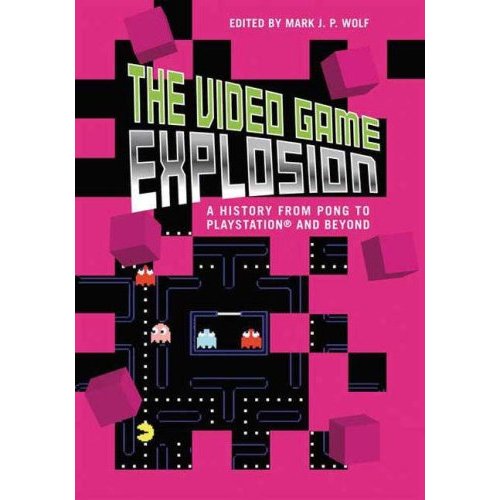

The Video Game Explosion

vg-explosion.jpg

A quick plug for a new book edited by my friend and colleague Mark J. P. Wolf, The Video Game Explosion: A History from Pong to PlayStation and Beyond (Westport, CT: Greenwood Press, 2008). I’ve worked with Mark before, on a collection he edited with Bernard Perron, The Video Game Theory Reader (New York: Routledge, 2003). Mark is a remarkable historian and scholar, with an exhaustive mind for detail, who’s been in on game studies from the start (here’s an interview with him at The Brainy Gamer). His goal with this volume is nothing less than a comprehensive reference work on the history of videogames. From his introduction:

This book differs from its predecessors in several ways. It is intended both for the general reader interested in video game history as well as for students with chapters thematically organized around various topics, which are generally arranged in chronological order and tell the story of video games from their earliest inception to the present day. Other features of the book include sidebars and profiles that highlight various aspects of video game history and a glossary of terminology relating to video games and their technology. Some of the best people writing on video games today have contributed their scholarship to form this comprehensive history. While other books on video games have been written from a journalistic, sociological, psychological, or nostalgic point of view, here the video games themselves occupy a central position. Other aspects of history, such as the companies, game designers, technology, merchandising, and so forth, provide a necessary background, but games always remain in the forefront.

The Video Game Explosion is divided into five sections, “Looking at Video Games,” “The Early Days (Before 1985),” “The Industry Rebounds (1985-1994),” “Advancing to the Next Level (1995-present),” and “A Closer Look at Video Games.” There are entries on almost every imaginable subtopic within videogame history, including system profiles of the Atari Video Computer System (VCS), the Nintendo Entertainment System (NES), and the PlayStation line; company profiles of Electronic Arts and Sega; genre profiles of adventure games, RPGs, and interactive movies; and a series of short essays examining videogame production in Europe, Asia, and Australia.

I particularly recommend the entries on “Rise of the Home Computer,” “Genre Profile: First-Person Shooting Games,” and the sidebar on “Retrogaming,” all written by yours truly.

Amazon link here; publisher’s page here.

Speed Indeed

speed-racer.jpg

The trailer for Speed Racer has been available for a little under a week, and word of it is spreading through social channels almost as quickly as through the manifold viral vectors of information space. (The world of organic embodied communications can only stand back and shake its head in wonder at its fleet digital progeny. YouTube’s version is here; I recommend viewing it in higher quality through the official website.) I’ve watched the trailer several times myself, in increasing fascination; students and colleagues have emailed me links to it; I even overheard two students discussing it excitedly, as though it were the movie itself: It’s already out? Cool! Whatever the merits of the work-in-progress the trailer is advertising, it has certainly achieved its intended purpose, acting not so much as a preview, but rather a demo of the full-length version that will hit theaters in May 2008. It captures the movie in miniature, scales it down to an iPod-sized burst of visual attractions and narrative beats.

I admit to being suckered (or sucker-punched) by the look of Speed Racer, a hypperreal funhouse crafted from neon candy and shot in an infinitely deep focus that would make Gregg Toland or James Wong Howe weep for joy. I guess it’s not surprising that Larry and Andy Wachowski, following up the silvery-green slickness of their Matrix trilogy, have prepared another film whose brand identity depends largely upon its visual texture: an internally consistent cinematic VR — a graphic engine in the truest sense — in which cinematography, visual effects, and mise-en-sc??ne have flowed into each other like gooey fudge.

Actually, add editing to that mix, for the Speed Racer trailer is the first I can think of to offer a scene transition as a visual hook. The image at the top of this article shows the endpoint of a camera move: tracking around protagonist Speed (Emile Hirsch), the background blurs into a rainbow ribbon, and Hirsch’s shoulder “wipes” the next shot into existence. The moment features prominently in the trailer and in stills grabbed from it (like the one I found by Googling), yet it seems to be neither a turning point in the narrative, a revelation of character, nor a generic marker. Instead, it showcases a new “verb” in film grammar, signaling that Speed Racer will not simply tell a great story, but will tell it using an entirely new set of rules.

Yeah, right. We’ve all heard this before; cinema probably started making promises it couldn’t keep on December 29, 1895, the day after the first public screening of a motion picture. But unlike the Lumi??re Brothers — who called cinema “an invention without a future” — the Wachowskis have set themselves the task of forging cinema’s next epoch. Whether they can do it with Speed Racer remains to be seen. On the surface, it’s a giddy experiment in mapping anime style into live action, though I suspect the production has stretched the concept of digital animation so far that any ontological divide between it and live action has long since ceased to matter. It may end up no more successful than Ang Lee’s Hulk (2003), which also toyed with a new kind of transition, in that case a pattern of orthogonal wipes based on comic-book panels. Lee’s experiment didn’t do much to pep up that dismal movie, but something tells me that Speed Racer will fare better. Here’s hoping.

Finding a Transmedia “Compass”

his-dark-materials-the-golden-compass-4.jpg

My colleague Tim Burke’s pointed rebuttal to critics of the film adaptation of The Golden Compass – who charge that the movie lacks the theological critique and intellectual heft of Phillip Pullman’s source novel – caught my eye, not just because I’m a fan of the books and intend to see the movie as soon as end-of-semester chaos dies down, but because I’ve spent the last week talking about transmedia franchises with my Intro to Film class.

To recap the argument, on one side you have the complaint that, in bringing book to screen, Pullman’s central rhetorical conceit has been cruelly compromised. The adventure set forth in the three volumes of His Dark Materials (The Golden Compass, The Subtle Knife, and The Amber Spyglass) unfolds against a world that is but one of millions in a set of alternate, overlapping realities. But the protagonist Lyra’s cultural home base is fearfully repressed by religious authorities whose cosmology allows for no such “magical thinking” – and whose defense of its ideology is both savagely militaristic and a thin veil over a much larger network of conspiracy and corruption. (Really, right-wing moral guardians should not be objecting to how Pullman treats the Church, but how he nails the current U.S. administration.) But, the charge goes, the movie has trimmed away the more controversial material, leaving nothing but a frantic romp through tableaux of special-effects-dependent set design and, in the case of Iorek Byrnison and the daemons, casting.

On the other side you’ve got positions like Tim’s, which welcome many of the excisions because they actually improve the story. As Pullman gets cranking, especially in the concluding Amber Spyglass, his narrative becomes both attenuated and obese, subjective time slowing to a crawl while mass increases to infinity like an space traveler moving near the speed of light. Personally, I was mesmerized by Spyglass’s long interlude in the Land of the Dead, which in its beautifully arid and disturbing tedium managed to remind me simultaneously of L’Avventura, Stalker, and Inland Empire. But it’s hard to disagree, especially when Tim reminds me how turgid and didactic C. S. Lewis’s The Last Battle got, that while we all like to have our intellect and imagination stirred, very few of us like to be lectured.

Me, I’ll suspend judgment on the movie until I see it – a strategy that worked well with The Mist, which I enjoyed astronomically more than Stephen King’s original novella. But I do sense in the debate around Compass’s political pruning an opportunity to air my concern with transmedia storytelling, or rather with the discursive framework that media scholars are evolving to talk about and critique transmedia “operations.”

In a nutshell, and heavily cribbed from Henry Jenkins’s Convergence Culture, storytelling on a large scale in contemporary media involves telling that tale across a number of different platforms, through different media, all of which are delegated one part of the fictional universe and its characters, but none of which contains the whole. While Star Trek and Star Wars did this starting in the 1960s and 1970s respectively, current exemplars like The Matrix bring the logic of transmediation to its full, labyrinthine flower. The three installments of the 1999-2003 trilogy are but land masses in a crowded sea of other textual windows into the Matrix “system”: videogames, websites, TV spots, comics, etc. each play their part. Each text is an entry point to the franchise; ideally, each stands alone on its artistic merits while contributing something valuable to the whole; and the pleasurable labor of transmedia audiences is to explore, collect, decrypt, and discuss the fragments as an ongoing act of consumption that is also, of course, readership.

Admittedly, Pullman’s trilogy doesn’t lend itself perfectly to transmediation any more than The Lord of the Rings did. When you’ve got to contend with an “original,” pesky concepts like canonicity and (in)fidelity creep in. Fans will always measure the various incarnations of Harry Potter against Rowling’s books, just as J. R. R. Tolkien’s fans did with Peter Jackson’s movies. But The Matrix or Heroes or Halo, which don’t owe allegiance to anything except their own protocols of ongoing generation, are freed through a kind of authorless solipsism to expand indefinitely through “storyspace,” no version more legitimate than another. (I’m not saying those franchises are literally authorless, but that they lack a certain auratic core of singular, unrepeatable authorship: instead they are team enterprises, all the more appealing to those who wish to create more content.)

There are some neat felicities between the transmedia system’s sliding panels — each providing a partial slice of a larger world — and the cosmological superstructure of His Dark Materials. (One could even argue that franchises come with their own pretender-gods, the corporations that seek to brand each profitable reality and police its official and unofficial uses, thus contradicting the avowed openness of the system: New Line as Magisterium.) But to come back to the question with which I opened, does it matter that, in turning Golden Compass the book into Golden Compass the movie – surely the first and most crucial “budding” of a transmedia franchise — some of the text’s teeth have been pulled?

I suggest that one danger of transmedia thinking is that it abandons, or at least dilutes, the concept of adaptation – a key tool by which we trace genealogical relationships within a world of hungrily replicating media. If A is an adaptation of B, then B came first; A is a version, an approximation, of B. We assess A against B, and regardless of which comes out the victor (after all, there have been good movies made of bad books), we understand that between A and B there are tradeoffs. There have to be, in order to translate between media, where 400 pages or the premise of a TV series rarely fit into a feature-length film.

The contradiction is that, while we would not usually expect an adaptation to precisely replicate the ideological fabric of its source, and can even imagine some that consciously go against the grain of the original, transmedia models, which talk of extensions rather than adaptations, assume a much more transparent mapping of theme and content. We expect, that is, the various splinter worlds of Star Trek and The Matrix to agree, in general, on the same ideological message: the commonsense “talking points” of their particular worldviews. We may get different perspectives on the franchise diegesis, but the diegesis must necessarily remain unbroken as a backdrop – or else it stops being part of the whole, abjected into a wholly different and incompatible franchise. (There’s a reason why Darth Vader will never meet Voldemort, except in fan fiction, which is a whole ‘nother ball of transmedial wax.)

Golden Compass’s critical “neutering” in the process of its replication reminds us that different media do different things, and that this has political import. Jenkins writes that, in transmedia, each medium plays to its strengths: videogames let you interact with – or inhabit — the story’s characters, while novelizations give internal psychological detail or historical background. Comic books and artwork visualizes the fiction, while model kits, costumes, and collectibles solidify and operationalize its props. Precisely because of the logic of transmedia, or distributed storytelling, we don’t expect these fragments to carry the weight of the whole. But each medium promotes through its very codes, technologies, and operations a particular set of understandings and values (a point not lost on Ian Bogost and other videogame theorists who talk about “persuasive games” and “procedural rhetoric”), hence translation always involves a kind of surgery, whether to expunge or augment.

Golden Compass may fail at the box office, which would end the Dark Materials franchise then and there (or maybe not – transmedia are as full of surprise resurrections and reboots as the stories told within them). But director/screenwriter Chris Weitz has made no secret of the fact that he sanitized the book’s theological transgressions in hopes that, having found an audience, he can go on to shoot the remaining two books more as Pullman intended. Regardless of what happens to this particular franchise, it’s our responsibility as scholars and critics – hell, as people – to be sensitive to, and wary about, the ideological filters and political compromises that fall into place, like Dust, as stories travel and multiply.