Paranormal Activity

paranormal-activity-bedroom1

[Some broad spoilers below]

I’ve said it before: these days, seeing certain movies means coming to the endpoint of an experience, rather than its beginning; closing a door rather than opening it. Think of how something like Star Wars in 1977 seeded an entire universe of story (and franchise) possibilities, or how The Rocky Horror Picture Show ignited a subculture of ritual performance and camp remixes of genre chestnuts. By contrast, a new kind of movie, exemplified currently by Paranormal Activity, hits theaters with a conclusive thump, like the punchline of a joke or the ending of a whodunit. After you’ve watched it, there is little more to say.

Such movies sail toward us on a sea of buzz, phantom vessels that hang maddeningly at the horizon of visibility, of knowability. Experienced fannish spotters stand with their spyglasses, picking out details in the mist and relaying their interpretations back to the rest of us. Insiders leak morsels of information about the ship’s construction and configuration. Old salts grumble about the good old days. It’s the modern cinematic equivalent of augury: awaiting the movie’s arrival is like awaiting a predestined fate, and we gaze into the abyss of our own inevitable future with a mixture of horror and appetite.

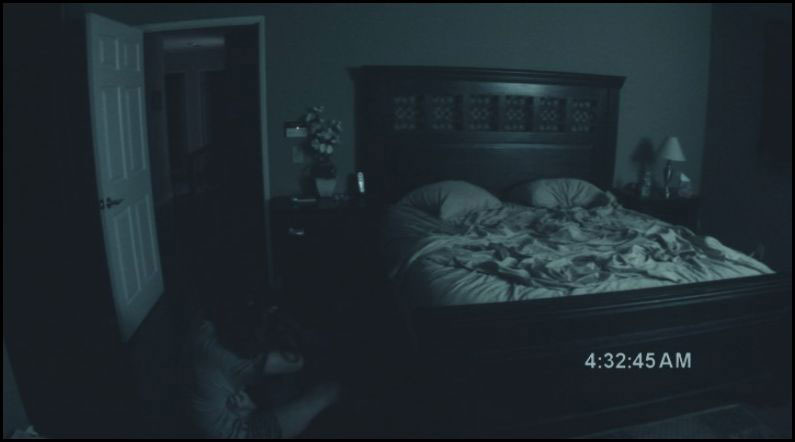
It sounds like I didn’t care for Paranormal Activity, but in fact I did; it’s as spare and spooky as promised, with a core of unexpected sweetness (due mainly to the performance of Katie Featherston) and consequently a sense of loss, even tragedy, at the end. It occurs to me that we are seeing another phenomenon in low-budget, buzz-driven, scary filmmaking: a trend toward annihiliation narratives. The Blair Witch Project, Open Water, Cloverfield, now Paranormal Activity — these are stories in which no one survives, and their biggest twist is that they disobey a fundamental rule of horror and suspense storytelling by which we understand that no matter how bad things get, at least one person, the hero, will make it through the gauntlet. With this principle guiding our expectations, we can affix our identifications to one or more figures, trusting them to safely convey us through the charnelhouse, evading the claws of monsters or razor-edged deathtraps.

No such comfort in the annihilation narrative, which blends the downbeat endings of early-70s New Hollywood with the clinical finality of the snuff film or autopsy report. Such brutal endings are encouraged by the casting of unknown or non-actors, whose public and intertextual lives presumably won’t be harmed by seeing them dispatched onscreen — though the more important factor, I suspect, is the blurring of the line between the character’s ontological existence and their own.

The usual symptom of this is identical first names: Daniel Travis plays Daniel Kintner in Open Water; Heather, Josh, and Michael are all “themselves” in Blair Witch; Paranormal‘s Katie and Micah are played by actors named Katie and Micah. There is, in other words, no supervening celebrity identity, no star persona, to yank us out of the fiction, to remind us simply by gravitational necessity that there must be a reality outside the fiction. The collapse of actor and character corresponds to the mockumentary mode that all these films share — a mode that itself depends on handheld cameras, recognizable, nonexotic settings, and an absence of standard continuity editing and background scoring.

Taken together, these factors (no-name actors, conscientiously unadorned and “unprofessional” filmmaking) would seem to recall Italian neorealism. But this being Hollywood, the goal is to tell stories that fit into familiar genres while reinventing them: horror seems to be the order of the day. A more subtle point is that, with the exception of Cloverfield‘s sophisticated matchmoving of digital monsters into shakycammed cityscapes, movies in this emerging genre cost almost nothing to make. The budget for Paranormal Activity was $11,000, a datum I didn’t even have to look up, because it’s been foregrounded so relentlessly in the film’s publicity. Oddly, these facts of the film’s manufacture don’t seem to detract from the envelope of “reality” in which its thrills are delivered; for all the textual (non)labor that goes into assuring us this really happened, we are just as entertained by the saga of scrappy Oren Peli and his sudden success as by the thumpings and scarrings inflicted on poor Micah and Katie.

And we are entertained, I think, by our own entertainment — the way in which we willingly give ourselves over to a machine whose cold operations we understand very well. I certainly felt this way as I took my seat at one of the few remaining non-multiplexed moviehouses in Ann Arbor, the tawdry but venerable State Theater. The 7 p.m. crowd was a throng of University of Michigan students, a few clusters of friends packed in with lots and lots of couples. Paranormal Activity is the kind of movie where you want to be able to clutch somebody. More to the point, it’s a genuine group experience: scares are amplified by a factor of ten when people around you are screaming.

Which brings me back to my opening point: we all knew what we were there for, even as the movie’s central mysteries — from the exact nature of its big bad to the specific escalating sequence of its scares — awaited discovery like painted eggs on an Easter-day hunt. (The film’s discretely doled-out shocks, which get us watching the screen with hypnotic attentiveness, are reminiscent of the animated GIFs one finds on the /x/ board of 4chan.) We were there for the movie, certainly, but we were also there for each other, enjoying the echo chamber of each others’ emotions and performative displays of fear. And we were there for ourselves, reverberating happily within the layers of our knowing and not-knowing, our simultaneous awareness of the film as cunning construct and as rivetingly believable bedtime story, our innocence and cynicism so expertly shaped by months of hype and misdirection, viral marketing, rumors and debunkings, word of mouth.

All of which constitutes, of course, the real paranormal activity: a mediascape that haunts and taunts us, foreshadowing our worst fears as well as our fiercest pleasures.
British Invasion

montypython

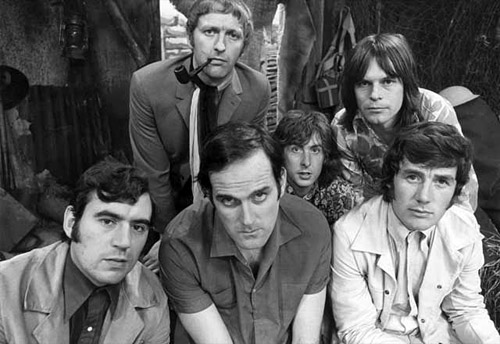
Ordinarily I’d start my post with a by-now-boilerplate apology for lagging behind the news, but in this case I will leave aside the ritual lament (“I’m just so busy this semester!”) and instead make proud boast of my lateness, boldly owning up to the fact that, although it was forty years ago last week that Monty Python’s Flying Circus had its first broadcast, I’m just getting around to remarking on it today. Seems only (il)logical to do so, given that one of Python‘s most fundamental and lasting alterations to the cultural landscape in which I grew up was to validate the non sequitur as an acceptable conversational — and often behavioral — gambit.

Let me explain. For me and my friends in grade school, the early-to-mid-seventies were a logarithmically-increasing series of social revelations, sometimes depressingly gradual, other times bruisingly abrupt, that we were “weird.” Our weirdness went by several aliases. The labels bestowed by forgiving parents and teachers were things like “smart,” “bright,” “eccentric,” “unusual,” and “creative.” Whereas the ones that arrived not from above but laterally, hurled like snowballs in the schoolyard or graffitied in ball-point across our notebooks, were more brutally and colorfully direct, and thus of course more convincing: “freak,” “spaz,” and — for me in particular, since it vaguely rhymes with Rehak — “retard.”

I see now that almost all of these phrases had their grain of truth, their icy core, their scored ink-line. In our weirdness we were smart and unusual and creative; we were also undeniably freakish, and as our emotional gyroscopes whirled wildly in search of some stable configuration, we were, by turns, spastically overenthusiastic and retardedly slow to adapt. We were book and comic readers, TV watchers, play actors, cartoon artists, model builders, rock collectors. We were boys. We liked science fiction and fantasy. Our skills and deficits were misdistributed and extreme: vastly vocabularied but garbled by braces and retainers; carefully observant but blindered by thick glasses; handsome heroes in our hearts, chubby or skinny buffoons in person. Many of us were good at science and math, others at art and theater. None of us did particularly well on the athletic field, though we did provide workouts for the kids who chased us.

Me, I made model kits of monsters like the Mummy, the Wolfman, and the Creature from the Black Lagoon — all supplied by the great company Aurora, with the last mile from hobby store to home facilitated by my indulgent parents — painted them in garish and inappropriate colors, situated them behind cardboard drum kits and guitars on yarn neckstraps, and pretended they were a rock supergroup while blasting the Monkees and the Archies from my record player. (I am not making this up.)

I was also a media addict, even back then, and when Monty Python episodes began airing over our local PBS station, I was instantly and utterly devoted to it. Which is not to say I liked everything I saw — a nascent fan, I quickly began drawing distinctions between the unquestionably great, the merely good, the tolerably adequate, and the terminally lame paroles that constituted the show’s langue, learning connections between these variations in quality and the industrial microepochs that gave rise to them: early, middle, and late Python. I had my favorite bits (Terry Gilliam’s animations, anything ever done or said by John Cleese) and my “mehs” (Terry Gilliam’s acting and the episode devoted to hot-air ballooning). Although or because I was stranded somewhere in the long latency separating my phallic and genital stages, I found every mention of sex and every glimpse of boob a fascinating magma of hypothetical desire and unearned shame. And, of course, it was all hysterically, tear-squirting, stomach-cramp-inducing funny.

The downside of Monty Python‘s funniness was the same as its upside: it gave all of us weirdos a shared social circuit. The show’s peculiar and specific argot of slapstick and trangression, dada and doo-doo, spread overnight to recess and classroom, connecting by a kind of dedicated party line any schlub who could memorize and repeat lines and skits from the show. In short, Monty Python colonized us, or more accurately it lit up like a discursive barium trace the preexisting nerd colony that theretofore had hidden underground in a nervous relay of quick glances, buried smiles, and raised eyebrows. Suddenly outed by a humor system from across the sea, we pint-sized Python fans stood revealed as a brotherhood of nudge-nudge-wink-wink, a schoolyard samizdat.

A good thing, but also a bad thing. The New York Times gets it exactly wrong when describing the “couple of guys in your dorm (usually physics majors, for some reason, and otherwise not known for their wit) who could recite every sketch”; according to Ben Brantley, “They could be pretty funny, those guys, especially if you hadn’t seen the real thing.” Nope — people who recite every Monty Python sketch are by definition not funny, or rather are funny only within an extremely bounded circle of folks who (A) already know the jokes and (B) accept said recitation as legal tender in their subcultural social capital. In my experience, there was no surer date-killer, no quicker way to get people to edge away from you at parties than by launching into such bonafide gems of genius as the Cheese Shoppe or the Argument Clinic. Yet we went on tagging each other as geek untouchables, comedy as contagion, as helpless before Pythonism’s viral spread as we would be, a few years on, by the replicating errata of Middle Earth and the United Federation of Planets.

Monty Python was merely the first infusion of obsessive-compulsive nerd scholarship into which I and my friends were forced by a series of cultural imports from Britain: grand stuff like The Fall and Rise of Reginald Perrin, The Hitchhiker’s Guide to the Galaxy, Alan Moore, and the computer game Elite. The three movies I like to name as my favorites of all time each have substantial UK components: Star Wars (1977) was filmed partly at Elstree Studios, Superman (1978) at Pinewood and Shepperton Studios, and Alien (1979), with Ridley Scott at the helm, at Shepperton and Bray Studios. And the trend continues right to present day: my favorite band is Genesis, I can’t get enough of Robbie Coltrane’s Cracker, and the science-fiction masterpiece of the summer was not District 9 (which gets high marks nevertheless) but the superb Children of Earth.

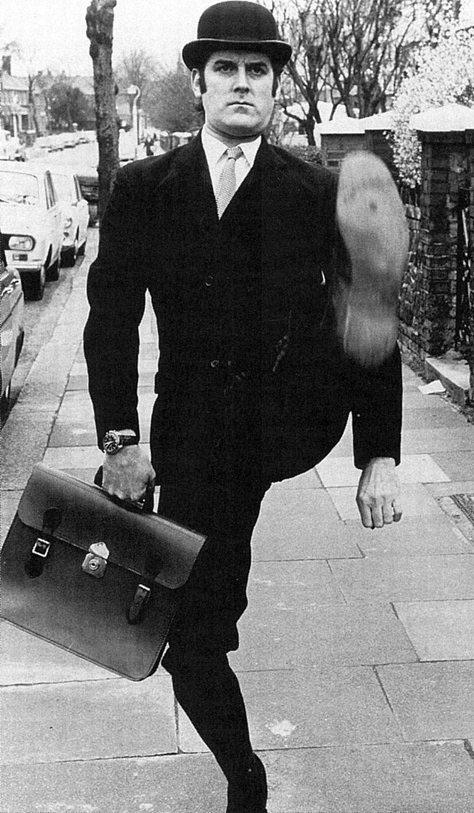
I sometimes wonder what to call this collection of British art and entertainment, this odd cultural constellation that seems to obey no organizing principle except its origins in England and its relevance to my development. How do you draw a boundary around a miscellany of so much that is good and essential about imaginary lives and their real social extrusions? Maybe I’m seeking a word like supergenre or metagenre, but those seem too big; try idiogenre, some way of systematizing a group of texts whose common element is their locus in a particular, historically-shaped subjectivity (my own) that is simultaneously a shared condition. The comic tragedy of the nerd, a figure both stranded on the social periphery yet crowded by his peers, lonely yet overfriended, renegade frontiersman and communal sheep, a silly-walking man with an entire Ministry of Silly Walks looming behind him.

I blame, and thank, England.

ministrysillywalks