One advantage to serialized narrative of the type I’ve been discussing with my class on TV & New Media this term is the way such stories occasionally align with the flocking of audiences to make a kind of collective reading ritual: conjoined at the internets, we witness each new installment together, previewing, receiving, discussing, digesting in happy cacophony. I remember the thrill of discovering this phenomenon back in the 90s with The X-Files, my first experience with “appointment television,” finding in the nascent USENET newsgroups next day more conversation, concentration, and conspiracy than I could handle. Till then, my pleasures had been too cultishly isolated (Red Dwarf, Mystery Science Theater 3000) or too relegated to reruns and the dislocated arrhythmia of syndication (the original Star Trek and its rebirth — in retrospect, a brilliant piece of franchise engineering — in Next Generation) to coalesce socially.
Nowadays, of course, fannish modes of attentiveness have become the rule rather than the exception, and Battlestar Galactica (followed closely by Lost) is perhaps the most mainstream subcultural artifact going. BSG is winding down, its four-season run drawing to a finish three episodes from tonight’s, and I’ve decided to mark the occasion with my own serial contribution: a set of four blog posts, one each Friday, to count down the end of the series. (I’ve written previously about BSG, and readers hungry for background might wish to check out my Flow essay.)
Even as I invoke the idea of some solid ending, it sounds hollow: for in confronting Galactica in its true multiplicity, one has to acknowledge that BSG has achieved critical mass for franchise immortality, its storyworld spinning off into extensions via TV, film, videogames, and on and on. A new series, Caprica, will be airing soon, along with a telefilm, The Plan, which together shift us into a period of history preceding the events of the current series. Prequelization — that odd retrograde movement into primal scenery — is the first symptom that a property has hit its transmedia singularity, backing and filling the fractal nooks and crannies of its narrative terrain. Let’s be honest, though. It won’t really be about narrative anymore, but instead a kind of rhizomatic self-historicization, an ongoing enterprise of mapping diegetic spacetime in all directions at once. On the textual side, it’s about generating more stories; on the industrial and commercial axis, it’s about maximizing profit returns, strip-mining the concept down to its bedrock. We saw what happened when George Lucas did this to Star Wars; let’s hope BSG doesn’t disappear quite so frictionlessly up its own asshole.
All that said, BSG has had a great run, arguably among the finest science-fiction TV series ever, up there with the best sustained stretches of Trek and Doctor Who. It’s mature, dark, intelligent, twisty, devoted to its own premise, and brilliantly cast and filmed. It’s wrapping up this particular incarnation long before series senility sets in — that creeping cancer that overwhelmed The X-Files around season seven and seems to long ago have sapped The Simpsons of its essence — and there is a genuine sense of drama, of something at stake, as the final episodes tick away.
Beyond these generalizations, though, and my eagerness to remain glued to my ringside seat, I don’t have much desire to review the show. Another aspect of serial narrative is that, while it’s unfurling in the realtime of broadcast, it’s like a train rushing by: each episode blurs past, delivering its individual punch, but the ultimate destination (and meaning/quality of the journey) is impossible to discern. There will be time for that, all the time in the world, when the series has concluded and we begin our long scholarship using DVD box sets and the Battlestar Wiki, canonizing favorite characters, arcs, and episodes, remixing our vids and building our model kits. The show will live on, that is, in our vernacular study and reverence of it, and if the franchise does go sour, at least we’ll always have Adama as singularly embodied by Edward James Olmos from 2004-2009. In these “countdown” posts, I’ll focus instead on more global aspects of BSG, from its place in science-fiction history to the aesthetics of its visual effects.
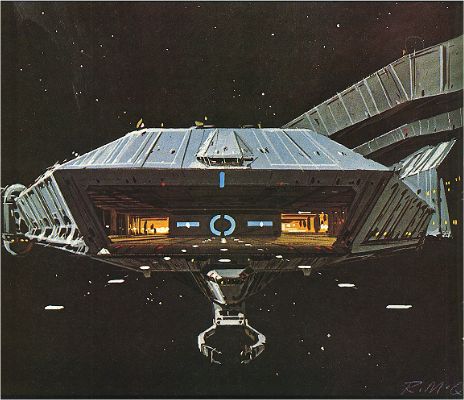
The image at the top of this post is from Ralph McQuarrie’s concept art for the 1970s series that launched Galactica (both ship and franchise) on its starlost voyage. In next week’s post, I’ll speak more about that incarnation of BSG and my own encounter with it in the shadows of that larger inspiration — from which Galactica gleefully cannibalized — Star Wars.