A-Z

As I throttle down for Thanksgiving week and a much-anticipated break from this busy semester (which I regret has allowed so little time for blogging), viruses are much on my mind: I await with some nervousness the onset of one of those academic-calendar colds that conveniently hold off until I’m done teaching. But other kinds of replicative infection are creeping into my life, today in the form of the Alphabet Meme, passed on to me by Chris Cagle of Category D, who caught it from Thom at Film of the Year. (I never realized how similar blogging and sex are: evidently when you link to someone, you link to everyone he or she has linked to.) Anyway, the goal of the exercise is a 26-item list of “Best Films,” corresponding to the letters of the alphabet. I’ll be forthright in acknowledging that my list has nothing to do with “bestness” and everything to do with love — simply put, the movies that mean the most to me. I’m a little too conscious of and skeptical about canonicity to nominate best-ofs; what is canon, anyway, but a kind of ubervirus, replicating within our taste hierarchies and the IPOs of cultural capital? The primary difference between irrational, irreducible favoritism and the stolid edifice of “the best that has been thought and said” (or in this case, filmed) is, it seems to me, one of authorship: the former is idiosyncratic, individual, owned, while the latter circulates unmoored in a kind of terrible immanence, its promiscuous power deriving precisely from its anonymity.

Or maybe I’m just feeling defensive. The list below, larded with science fiction and pop pleasures, nakedly exposes me as a cinematic philistine, a clear case of arrested development. How I reconcile this with my own day job of reproducing the canon (teaching Citizen Kane and Il Conformista semester after semester), I don’t know. But with turkey and stuffing on the horizon, I choose to leave the soul-searching to another day.

Before sharing my list, I believe I’m supposed to spread the meme to five other victims, er, friends. Let’s see: how about valued contributors Michael Duffy and MDR; Dan North at Spectacular Attractions; Nina Busse of Ephemeral Traces; and Tim Burke of Easily Distracted?

MY LIST

Alien
Battle Beyond the Stars
Close Encounters of the Third Kind
Die Hard
The Exorcist
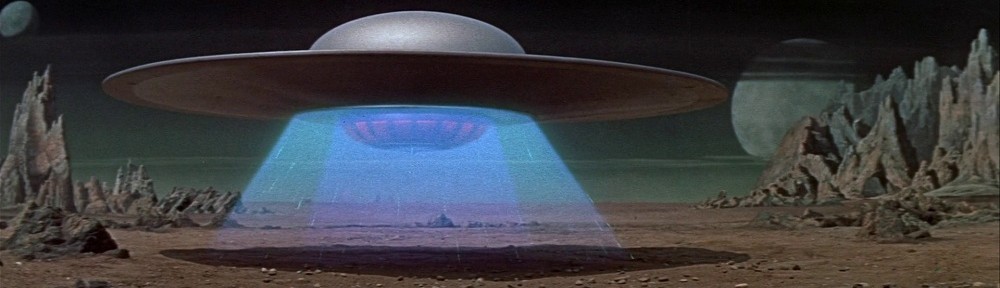
Forbidden Planet
Groundhog Day
Harold and Maude
Invasion of the Body Snatchers (1978)
Jacob’s Ladder
King Kong (1933)
Logan’s Run
Miracle Mile
Night of the Living Dead (1968)
Outland
The Parallax View
The Quiet Earth
Run Lola Run
Superman (1978)
Terminator 2: Judgment Day
Ugetsu Monogatari
The Vanishing
The Wizard of Oz
X: The Man with the X-Ray Eyes
Young Frankenstein
Zardoz
Holograms

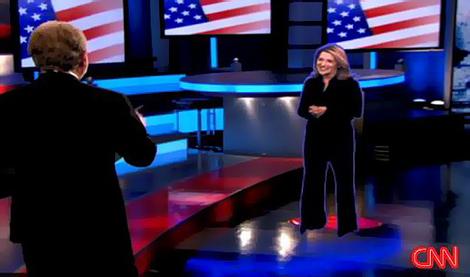
It’s still Jessica Yellin and you look like Jessica Yellin and we know you are Jessica Yellin. I think a lot of people are nervous out there. All right, Jessica. You were a terrific hologram.

— Wolf Blitzer, CNN

I woke this morning feeling distinctly unreal — a result of staying up late to catch every second of election coverage (though the champagne and cocktails with which I and my wife celebrated Obama’s amazing win undoubtedly played a part). But even after I checked the web to assure myself that, indeed, the outcome was not a nighttime dream but a daylight reality, I couldn’t shake the odd sense of being a projection of light myself, much like the “holograms” employed by CNN as part of their news coverage (Here’s the YouTube video, for as long as it might last):

I’ve written before on the spectacular plenitude of high-definition TV cross-saturated with intensive political commentary, an almost subjectivity-annihilating information flow on the visual, auditory, and ideological registers. In the case of CNN’s new trick in the toolbox, my first reaction was to giggle; the projection of reporter Jessica Yellin into the same conversational space as Wolf Blitzer was like a weird halftime show put on by engineering students as a graduation goof. But the cable news channel seemed to mean it, by God, and I have little doubt that we’ll see more such holographic play in coverage to come, as the technology becomes cheaper and its functionality streamlined into a single switch thrown on some hidden mixing board — shades of Walter Benjamin’s observation in “The Work of Art in the Age of Mechanical Reproduction” about striking a match.

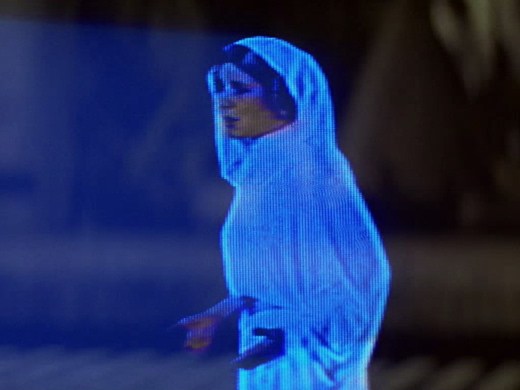
Leaving aside the joking references to Star Wars (whose luminously be-scanlined projection of Princess Leia served, in 1977, to fold my preadolescent crush on Carrie Fisher into parallel fetishes with science-fiction technology and the visual-effects methods used to create them), last night’s “breakthrough” transmission of Yellin from Chicago to New York contains a subtle and disturbing undertone that should not be lost on feminist critics or theorists of simulation. This 2008 version of Alexander Graham Bell’s “Mr. Watson — Come here — I want to see you” employed as its audiovisual payload a woman’s body. It was, in this sense, just the latest retelling of the sad old story in which the female form is always-already rendered a simulacrum in the visual circuits of male desire. Yellin’s hologram, positioned in compliant stasis at the twinned focus of Blitzer’s crinkly, interrogative gaze and a floating camera that constantly reframed her phantasmic form, echoed the bodies of many a CG doll before it: those poor gynoids, from SIGGRAPH’s early Marilyn Monrobot to Shrek‘s Princess Fiona and Aki Ross in Final Fantasy: The Spirits Within, whose high-rez objectification marks the triumphal convergence of representational technology and phallic hegemony.

But beyond the obvious (and necessary) Mulveyan critique exists another interesting point. The news hologram, achieved by cybernetically tying together the behavior of two sets of cameras separated by hundreds of miles, is a remarkable example of realtime visual effects: the instantaneous compositing of spaces and bodies that once would have taken weeks or months to percolate through the production pipeline of even the best FX house. That in this case we don’t call it a visual effect, but a “news graphic” or the like, speaks more to the discursive baffles that generate such distinctions than to any genuine ontological difference. (A similar principle applies to the term “hologram”; what we’re really seeing is a sophisticated variant of chroma key, that venerable greenscreen technology by which TV forecasters are pasted onto weather maps. In this case, it’s been augmented by hyperfast, on-the-fly match-moving.) Special and visual effects are only recognized as such in narrative film and television — never in news and commercials, though that is where visual-effects R&D burns most brightly.

As to my own hologrammatic status, I assume it will fade as the magic of this political moment sinks in. An ambiguous tradeoff: one kind of reality becoming wonderfully solid, while another — the continuing complicity between gendered power and communication / imaging technology — recedes from consciousness.