The Id Machine

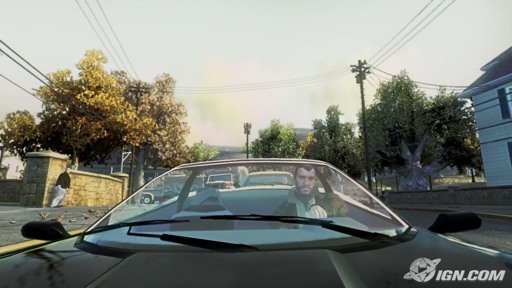
In one of those media events so global — perhaps solar-systemic? — in scope that you hardly need me to remind you about it, Grand Theft Auto IV launches today. Early word on Rockstar’s latest is everything it ought to be: game reviewers are enraptured, moral guardians enraged. Me, I’m just waiting to get my hands on the thing, which manifests in this world as a silver disk in a bright-green plastic case, but becomes in the space of the screen another totemic circle: a steering wheel. Maybe more than any other virtual-world franchise, GTA toggles its players smoothly between human and automotive avatars, encasing us in cars for such long stretches of gametime that, as Tycho at Penny Arcade writes, you might end up just “sitting in a parking lot listening to the radio.”

The webcomic associated with Tycho’s post makes another good point about Grand Theft Auto, namely that its possible pathways are so seemingly infinite in number that they risk numbing the player with the paralysis of “total freedom.” The opposite of the rail shooter to which I compared the Harry Potter novels a few posts back, GTA and its ilk are better described as sandbox games, which emphasize the open-endedness of play. Now, I admit to being skeptical of such neat distinctions, believing in my curmudgeonly way that the sense of unbounded possibility offered up by most “interactive” experiences is just that: a phantasmic structure of feeling, conveniently packaged and sold to us in the same way that advance hype about the summer movie season is more the actual commodity than the movies themselves. (That said, I’m looking forward, same as always, to things like Iron Man, Indiana Jones and the Kingdom of the Crystal Skull, The Dark Knight, and — mmmm yes — Speed Racer.) It’s a matter of perception, not pathways. The most scripted of videogames (if done well) can get my heart thumping with the sense that anything might happen next, while GTA, no matter how many gigabytes of gamedata and corresponding square mileage of explorable diegesis it may offer, can still wear out its welcome. Though I played both avidly, I never finished either Grand Theft Auto III or its sequel, Vice City.

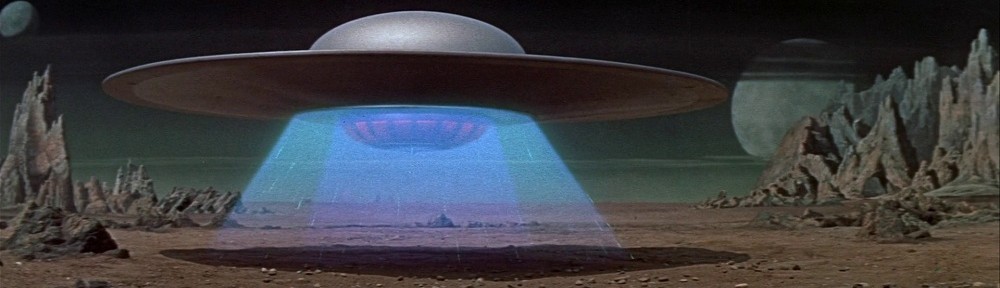
That said, I never played anything as gripping, anarchic, and sensual, either. My friend Chris Dumas calls GTA the “id machine,” and he’s right. Like the Krell technology buried beneath the surface of Altair IV in Forbidden Planet, GTA is a visualization engine for the subconscious, pipelining our nastiest, bloodiest impulses into daylight, setting loose neon monsters we didn’t know we had in us. It’s insane fun to play and, like the best videogames, cinematically engrossing to observe. It’s also perversely Bazinian in form. As a grad student in 2002, I wrote a paper called “Grand Theft Auto 3 and the Interface of the Everyday,” arguing that GTA is at heart a simulation — not of mechanical or physical processes, but urban experience. Here’s the intro:

With its heightened violence, black humor, and mise-en-scene reminiscent of blaxploitation and vigilante films from the 1970s and Quentin Tarantino’s postmodern recyclings in movies such as Reservoir Dogs (1992) and Pulp Fiction (1994), GTA3 seems to stand apart from the tradition of simulation games, so much so that its simulationist tendencies are perceptible only upon reflection; on first glance it is more likely to be put into the category of “shoot-em-up” games such as Doom, Quake, and other first-person shooters, or hand-to-hand fighting games such as Tekken and Mortal Kombat. I argue, however, that GTA3 actually represents the culmination, in a form so pure as to be almost unrecognizable, of a particular simulationist logic that has heretofore stayed comfortably submerged in videogames: the notion of urban realism. Or rather, a refracted and stylized realism whose excesses should not be allowed to obscure its essential goal: the representation of modern urban existence, complete with dead time, bad weather, traffic lights, blaring radio stations, law enforcement by turns oblivious and aggressive, and a totalizing motif of passage – endless motion through the city’s spaces on foot or (more often) behind the wheel of a car, from the vantage point of which Liberty City’s bridges and skyscrapers, storefronts and pedestrians, become spectacles simultaneously mundane and beautiful.

In this sense, GTA3 follows a logic of modernity articulated by Walter Benjamin and Siegfried Kracauer, and before them Baudelaire, whose epigrammatic summation of modernity as “the transient, the fleeting, the contingent” set the terms for a discourse of ephemera – the idea that the truth of contemporary existence, and perhaps the key to its revolutionary reform, resides not in the monumental and “historic” but in the unnoticed and ordinary. In this paper I shall explore the idea that GTA3 makes the everyday its object of simulation, interaction, and pleasure, enabling users to play within the environs of a stylized urban reality as a way of experiencing, and reflecting upon, their own place in the world and position in society. In the second half of the paper I move toward a consideration of videogames in general, setting them against a backdrop of twentieth-century technologies, in order to argue that videogames share a function that Benjamin identified as “subject[ing] the human sensorium to a complex kind of training” in which “perception in the form of shocks [is] established as a formal principle.” Under this view, the content of Grand Theft Auto (which concerns itself textually with an alternating rhythm of shocks and boredom) merges with the formal operations of videogames, which, consumed in unmarked leisure time, reflect changes wrought in consciousness by technology and industrialization, similar to Benjamin’s description of the Fun Fair whose Dodgem cars achieve “a taste of the drill to which the unskilled laborer is subjected in the factory.” I begin with a consideration of three main components of GTA3’s play: the city, the flâneur, and the car.

Looking at this argument today, it doesn’t seem too earthshaking; Gonzalo Frasca explores some similar ideas in his 2003 essay “Sim Sin City.” It may be that with the advancing tide of computer graphics, we’re less scandalized by the notion that videogames can stand in, even substitute for, the visual and auditory sensorium through which we filter and know reality. Games, that is, increasingly engage in a double simulation, first of our lived sensory existence and only secondarily of more ephemeral (but nonetheless meaningful) matters: ethics, aesthetics, class consciousness. In the case of GTA, the subjectivity tourism is that of a violent, animalistic, unforgiving struggle to survive on the streets, something that its player demographic will likely never confront. GTA provides in musical flashes a world we recognize as our own even as we comfortably disavow it through the technological trick of switching off the console: inverting the hypodermic needle’s injection, we anesthetize ourselves precisely by unplugging, retreating from the raw truth of the made-up game into the ongoing dream of our privileged, protected lives.
Gearing up for Santa Barbara

I leave in a few days for the Console-ing Passions conference in Santa Barbara. I’d be excited just because of the location (the conference concludes with a beach party, for gosh sakes) or the nature of the professional gathering itself, since I had a wonderful time at Console-ing Passions in New Orleans in 2004. But most of all I’m thrilled to be taking part in a workshop discussion that grew out of the gender-and-fandom debates hosted by Henry Jenkins last summer. My colleagues Julie Levin Russo (Brown University), Louisa Stein (San Diego State University), Sam Ford (Massachusetts Institute of Technology), and Suzanne Scott (University of Southern California) all participated in those male-female pairups, and we formulated the CP workshop as a space not just to present our own research, but engage in a dialogue about where that massive, months-long conversation has left us as fan scholars who confront issues of gender, power, privilege, and creativity

The workshop, which takes place Friday morning, is entitled Gendered Fan Labor in New Media and Old. Each of us will speak briefly about a current research interest or project, based on a text or media artifact that raises questions about creative media fandom in both its historical and contemporary dimensions and which focuses on gendered labor as an axis intersecting multiple concerns: taxonomies of fan practice, shifting economic relations between consumers and producers, questions of legitimacy and legality, the impact of new technologies, and the increasing visibility in popular, industrial, and academic discourses of heretofore marginal(ized) fan communities. Second, we hope to perform a kind of post-mortem on the summer’s debates: highlighting certain recurring themes, tendencies, and absences that structured the discourse, unpacking problematic areas, and reflecting both on what went well or badly in the past, and where we might productively go in the future. Here are the others’ projects, full versions of which are viewable on LiveJournal’s fandebate (thanks to Kristina Busse):

  • Julie Levin Russo, “The L Word: Labors of Love”
  • Sam Ford, “Outside the Target Demographic: Surplus Audiences in Wrestling and Soaps”
  • Suzanne Scott, “From Filking to Wrocking: The Rock Star/Groupie Dialectic in Harry Potter Wizard Rock”
  • Louisa Stein, “Vidding as Cultural Narrative”

My own project, “Boys, Blueprints, and Boundaries: Star Trek‘s Hardware Fandom,” examines a subset of Trek fandom that devotes itself to the literal mapping of Trek‘s canonical universe and recreating in material form its diegesis through activities such as the drafting of episode guides and concordances, the manufacture of costumes, props, and model kits, and the making of technical manuals and blueprints. The first paragraph is quoted below; you can also read the full (short) paper at LiveJournal. Comments on the project welcomed and appreciated!

The recent legal dispute between J. K. Rowling, author of the Harry Potter novels, and Steven Vander Ark, a Michigan librarian who has compiled an internet guide to the Harry Potter “universe,” raises many interesting questions about copyright, authorial power, and what might be called a double standard of contemporary media production in which potentially infringing online publication is tolerated, even welcomed, by copyright holders, while the equivalent publication in print form is energetically resisted. But viewed through the lenses of fandom and gender, the Rowling / Vander Ark case illuminates another and much older conundrum, consisting of a linked pair of problematic binaries. On one hand, there is the contrast between fan-produced materials which creatively transform an original work (like fanfic, slash, vidding, filksongs, and artwork) and those which “merely” document, map, or archive the original work (like concordances, episode guides, blueprints, and technical manuals). On the other hand, there is the apparent gender split between the traditionally female fans who produce work considered to be transformative, and male fans whose productivity tends instead toward the technical and archival. The relationship between male fans and what I will call “blueprint culture” is the subject of this short paper, in which I consider gendered fan labor as it is manifested in fantasy and history; ways of rethinking this labor as creative and transformative; and current trends that reflect the growing impact of blueprint culture in both industrial and academic domains.

Cartographers of (Fictional) Worlds, Unite!

J. K. Rowling’s appearance in a Manhattan courtroom this week to defend the fantasy backdrop of her Harry Potter novels is interesting to me for several reasons. It dovetails with a conversation I’ve been having in the Fan Culture class I’m teaching this semester, about the vast world-models that subtend many franchise fictions (e.g. the “future history” of Star Trek, the Middle-Earth setting of Lord of the Rings, the Expanded Universe of Star Wars, and so on). In his writing on subcreation, J. R. R. Tolkien calls these systematic networks of invented facts, events, characters, and languages “secondary worlds,” but more recently the phenomenon has been given other labels by media theorists: master text, hyperdiegesis. Henry Jenkins has put forth the most influential formulation with his concept of transmedia storytelling, which recasts franchise fictions like The Matrix as a kind of generative space — a langue capable of ceaseless acts of fictional parole — which can be accessed through any number of its “extensions” in disparate media.

One might say, in an excess of meta-thinking, that the notion of the storyworld itself floats suspended among these various theoretical invocations: a distributed ghost of a concept that feels increasingly “real.” As our media multiply, overlap, and converge in a spectacular mass ornament like a Busby Berkeley musical number, we witness a contrasting, even paradoxical, tendency toward stabilization, concreteness, and order in our fictional universes.

A key agency in this stabilization is the cataloging and indexing efforts of fans who keep track of sprawling storylines and giant mobs of dramatis personae, cross-referencing and codifying the rules of seriality’s endless play of meaning. Most recently, these labors have coalesced in communally-maintained databases like Lostpedia, the Battlestar Wiki, and — yes — the Harry Potter Lexicon at the heart of the injunction that Rowling is seeking. The conflict is over a proposed book project based on the online Lexicon, a fan-crafted archive of facts and lore, characters and events, that make up the Harry Potter universe. Although Rowling has been sanguine about the Lexicon till now (even admitting that she draws upon it to keep her own facts straight), the crystallization of this database into a for-profit publication has her claiming territorial privilege. Harry, Hermione, and Ron — as well as Quidditch, Dementors, and Blast-Ended Skrewts — are emphatically Rowling’s world, and we’re not quite as welcome to it as we might have thought.

At issue is whether such indexing activities are protected by the concept of transformative value: an emerging legal consensus that upholds fan-produced texts as valid and original so long as they add something new — an interpretive twist, a fresh insight — to the materials they are reworking. (For more on this movement, check out the Organization for Transformative Works.) Rowling asserts that the Harry Potter Lexicon brings nothing to her fiction that wasn’t there already; it “merely” catalogs in astonishing detail the contents of the world as she has doled them out over the course of seven novels. And on the surface, her claim would seem to be true: after all, the Lexicon is not itself a work of fiction, a new story giving a new slant on Harry and his adventures. It is, in a sense, the opposite of fiction: a documentary concordance of a made-up world that treats invention as fact. Ideologically, it inverts the very logic of make-believe, but in a different way from behind-the-scenes paratexts like author interviews or making-of featurettes on DVDs. We might call what the Lexicon and other fan archives do tertiary creation — the extraction of a firm, navigable framework from a secondary, subcreated world.

But is Rowling’s case really so straightforward? It seems to me that what’s happening is a turf battle that may be rare now, but will become increasingly common as transmedia fictions proliferate. The Lexicon, whether in print or cybertext, does compete with Rowling’s work — if we take that “work” as being primarily about building a compelling, consistent world. The Lexicon marks itself as a functionally distinct entity by disarticulating the conventional narrative pleasures offered by Rowling’s primary text: what’s stripped away is her voice, the pacing and structure of her storytelling. By the same token, however, the Lexicon produces Rowling’s world as something separate from Rowling. And for those readers for whom that world was always more compelling than the specific trajectories with which Rowling took them through it (think of the concept of the rail shooter in videogames), the Lexicon might indeed seem like a direct competitor — especially now that it has migrated into a medium, print, that was formerly Rowling’s own.

The question is: what happens to secondary worlds once they have been created? What new forms of authority and legitimacy constellate around them? It may well be the case that the singular author who “births” a world must necessarily cede ownership to the specialized masses who then come to populate it, whether by writing fanfic, building model kits and action figures, cosplaying, roleplaying, or — in the Lexicon’s case — acting as archivists and cartographers.

Before the Internet, such maps were made on paper, sold and circulated among fans. One of my areas of interest is the “blueprint culture” that arose around Star Trek and other science-fiction franchises in the 1960s and 1970s. I’ll be speaking about this topic at the Console-ing Passions conference in Santa Barbara at the end of April, but Rowling’s lawsuit provides an interesting vantage point from which to blend contemporary and historical media processes.