A Ping from the Blogosphere

I don’t know how wise it is to shout out to one’s own shout-out; all the cross-blogging and interlinking might prove too much for the ephemeral fabric of the cybertextual continuum, opening a raw singularity out of which droning fleets of gramophones, films, and typewriters will fly like the repressed of our lost predigital literacies. Still, that won’t stop me from thanking Henry Jenkins for the kind mention of Graphic Engine on his blog, Confessions of an Aca-Fan. His take on my postings here, in particular those regarding the Harry Potter series [1], [2], [3], is very generous (and a reminder that I have another post or two in the pipeline on this subject). I’m especially happy to be showcased on Confessions of an Aca-Fan because Henry’s blog, along with Jason Mittell’s and Tim Burke’s, were what inspired me to dive into blogging this summer.

For the last several months, Henry’s been hosting an ongoing conversation/debate about gender and fandom, pairing male and female “aca-fen” for public dialogues (here’s the inaugural entry). My turn is coming up in a few weeks, when I’ll be discussing fandom and gender in light of new media industries with Suzanne Scott, a doctoral student at USC. My initial conversations with Suzanne have been fun and enlightening, and I look forward to sharing our discourse when the spotlight falls on us later in September.

As for Henry Jenkins, well, he’s an up-and-coming scholar with a very bright future. I’d keep my eye on him.

Coming Soon: Videogame/Player/Text

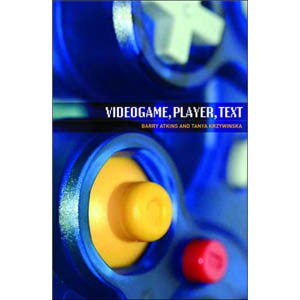
This is a plug for a new collection on videogame theory, Videogame/Player/Text, that’s just about to be published by Manchester University Press (here’s the official announcement). The editors, Barry Atkins and Tanya Krzywinska, came up with a great idea: invite game scholars to contribute chapters in which they turn a videogame of their choice inside out, upside down, and shake it wildly to see what insights tumble out.

Videogame/Player/Text

For me, Videogame/Player/Text was an opportunity to return to the subject of first-person shooters, which have interested me both as a player and an academic since my early days in grad school. (My master’s thesis, a Lacanian reading of FPS history written at the University of North Carolina at Chapel Hill, later became a chapter called “Playing at Being: Psychoanalysis and the Avatar” in The Video Game Theory Reader [Routledge, 2003], edited by Mark J. P. Wolf and Bernard Perron — Amazon link here.)

For Tanya and Barry’s collection, I wanted to get away from the puzzle of retrofitting film theory to videogames (which is still, for many game scholars, anathema) and write in a more medium-specific manner. My focus in “Of Eye Candy and Id: The Terrors and Pleasures of Doom 3” is the evolution of graphic engines, the software component that renders 3D spaces from a subjective viewpoint and is an integral part — the kernel, really — of FPS experience. What I take on in my article for V/P/T is the question of when, exactly, graphic engines came into existence, both as a technical and discursive category; how graphics have generally been talked about in dialectical relation to gameplay; and how the evolution of 3D graphics relates to player embodiment, isolation, and solipsism. As a teaser, the opening paragraphs of my V/P/T essay are quoted here:

Let’s start with a claim often heard about Doom 3 (Activision/id Software, 2004): that it is “just” a remake of the 1993 original, the same stuff packaged in prettier graphics. That, although separated by eleven years and profound changes in the cultural, technological, and aesthetic dimensions of videogaming, Doom 3 – like all of Doom’s versions – boils down to a single conceit, recycled in the contemporary digital argot:

First, people are taken over, turned into cannibal Things. Then the real horror starts, the deformed monstrosities from Outside. … Soon, brave men drop like flies. You lose track of your friends, though sometimes you can hear them scream when they die, and the sounds of combat echo from deep within the starbase. Something hisses with rage from the steel tunnels ahead. They know you’re here. They have no pity, no mercy, take no quarter, and crave none. They’re the perfect enemy, in a way. No one’s left but you. You … and them.

Here the second-person voice does to readers what Doom so famously did to players, isolating them in a substitute self, an embattled, artificial you. The original Doom had its shareware release on December 10, 1993, marking the popular emergence of the first-person shooter or FPS. Less a game than a programming subgenre all its own, Doom’s brand of profane virtual reality was built around a set of graphical hacks – an “engine” of specialized rendering code – that portrayed navigable, volumetric environments from eye-level perspective. Players peered over shotgun barrels at fluidly animated courtyards and corridors, portals and powerups, and “deformed monstrosities” like the fireball-hurling Imp, the elephantine Mancubus, and the Cyberdemon (“a missile-launching skyscraper with goat legs”).

Technologically, Doom depended on advances in computer sound and imaging, themselves a result of newly affordable memory and speedy processors. Psychologically, the FPS stitched the human body into its gameworld double with unprecedented intimacy. Gone were the ant-farm displacements of third-person videogames, the god’s-eye steering of Pac-Man (Namco, 1980) and the sidescrolling tourism of Super Mario Brothers (Nintendo, 1985). Doom fully subjectivized the avatar – the player-controlled object around which action centers – turning it into a prison of presence whose embodied vulnerability (they’re coming for me!) deliciously complemented its violent agency (take that, you bastard!).

Shooters that followed – Unreal (GT Interactive/Epic, 1998), Half-Life (Sierra/Valve, 1998), Deus Ex (Eidos Interactive/Ion Storm, 2000), Halo (MS Game Studios/Bungie, 2001), and countless others – deepened the FPS formula with narrative and strategic refinements, not to mention improvements in multiplayer, artificial intelligence, and level design. But to judge by its latest iteration, the Doom series didn’t bother to evolve at all – except in terms of technical execution. …

As for the rest of V/P/T‘s contents, they look fascinating, and I’m very much looking forward to reading them. A lot of friends among the contributors, and a lot of writers whose work I respect. Here’s the chapter lineup:

  • Introduction: Videogame, player, text – Barry Atkins and Tanya Krzywinska
  • Beyond Ludus: narrative, videogames and the split condition of digital textuality – Marie-Laure Ryan
  • All too urban: to live and die in SimCity – Matteo Bittanti
  • Play, modality and claims of realism in Full Spectrum Warrior – Geoff King
  • Why am I in Vietnam? – The history of a video game – Jon Dovey
  • ‘It’s Not Easy Being Green’: real-time game performance in Warcraft – Henry Lowood
  • Being a determined agent in (the) World of Warcraft: text/play/identity – Tanya Krzywinska
  • Female Quake players and the politics of identity – Helen W. Kennedy
  • Of eye candy and id: the terrors and pleasures of Doom 3 – Bob Rehak
  • Second Life: the game of virtual life – Alison McMahan
  • Playing to solve Savoir-Faire – Nick Montfort
  • Without a goal – on open and expressive games – Jesper Juul
  • Pleasure, spectacle and reward in Capcom’s Street Fighter series – David Surman
  • The trouble with Civilization – Diane Carr
  • Killing time: time past, time present and time future in Prince of Persia: The Sands of Time – Barry Atkins

Videogame/Player/Text should be published by the end of September from Manchester University Press. I invite you to check it out.

Remembered for His Monsters

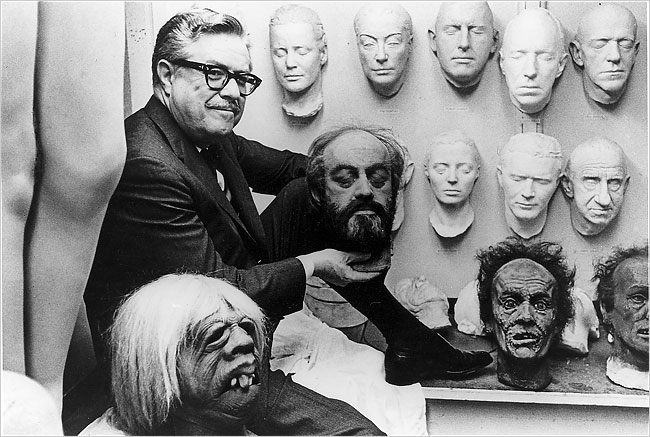
William Tuttle

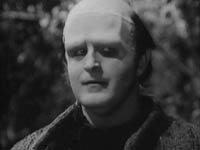
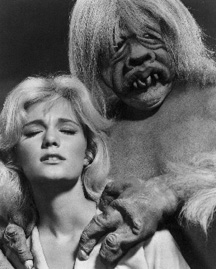
With sadness and a sweet sense of nostalgia I note the passing of one of the great effects technicians, William Tuttle, who died July 27. (The NY Times obituary is here; you may need to register with the site to view it.) Tuttle headed the makeup department of MGM and worked on many films I remember fondly from when I was a kid: The Fury (the 1978 Brian DePalma film that ends with the explosion of John Cassavettes); Logan’s Run (1977), in which he turned Roscoe Lee Brown into a silver-faced cyborg artist nutcase named Box; Young Frankenstein (1974), where Tuttle’s makeup for Peter Boyle both satirized and honored Jack Pierce’s artistry in the 1931 Frankenstein; and “The Night Strangler” (1973), one of the pair of telefilms that launched the TV series Kolchak: The Night Stalker. Tuttle also did standout work in The Seven Faces of Dr. Lao (1964) and The Time Machine (1960), creating a morphing set of identities for Tony Randall in the former and the fearsome Morlocks in the latter.

Young FrankensteinThe Time Machine

If you recognize in this retrograde stroll through Tuttle’s filmography the archival trace of IMDb, you’re exactly right; I called up that website reflexively, using it, as I so often do, as a prosthetic augmentation of my mediagoing memories. What’s interesting in this case is how much of Tuttle’s work I was completely unaware of: all the non-monstrous, un-fantastic makeup jobs he did on Hollywood stars, making them look glamorous or rugged or merely screen-real instead of bizarre. Perhaps Tuttle’s best-known creation — in that it triggers for a much of a certain TV-watching generation an avalanche of networked associations to black-and-white anthology dramas, smart SF & fantasy, and twist endings — played on just that split between the “normal” and the “hideous,” in the episode of The Twilight Zone entitled “Eye of the Beholder” (1960). Almost as unmistakably recognizable as Rod Serling’s wry face and voice is the twisted visage of the medical staff unveiled in “Beholder”‘s wrenching final images. For all the faces that William Tuttle helped to look pretty or handsome, it’s the monsters we’ll remember him for.

Eye of the Beholder

Movie-a-Day: July 2007

It had to happen: after an exhilarating summer of bulk viewing — the optical equivalent of chain smoking, except that instead of reducing my capacity to “inhale,” it seems to have forced open some kind of cognitive-perceptual valve, allowing me to absorb much greater quantities of cinematic information than ever before — I hit a wall. Preparing my courses for the fall is the main culprit; in a few weeks I start teaching Swarthmore’s venerable Introduction to Film and Media Studies, but also a class of my own design, Animation and Cinema. My wife and I are also gearing up to move into our new house in September, creating lots of fun details to obsess over, like remodeling our kitchen. With all of this going on, I only made it through about thirteen movies in August, an ignominous list I’ll post later.

But. Here from less hectic times is the complete list for July, in which I watched 36 movies — a personal record. Once again, I’ve placed stars next to the titles that made a particularly strong impact on me.

Movie-a-Day: July 2007

Shock Corridor (Sam Fuller, 1963)
Duel in the Sun (King Vidor, 1946)
On the Waterfront (Elia Kazan, 1954)
McCabe & Mrs. Miller (Robert Altman, 1971)*
Five Easy Pieces (Bob Rafelson, 1970)*
Magnificent Obsession (Douglas Sirk, 1954)
The Conformist (Bernardo Bertolucci, 1970)
Ratatouille (Brad Bird, 2007)
The Naked Kiss (Sam Fuller, 1964)
Broken Arrow (Delmer Daves, 1950)
Days of Heaven (Terence Malick, 1978)*
Howl’s Moving Castle (Hayao Miyazaki, 2004)
Imitation of Life (Douglas Sirk, 1959)*
The Ten Commandments (Cecil B. DeMille, 1956)
The 400 Blows (François Truffaut, 1959)
Zodiac (David Fincher, 2007)
La Grande Illusion (Jean Renoir, 1937)
Knocked Up (Judd Apatow, 2007)*
Sans Soleil (Chris Marker, 1983)
Bamboozled (Spike Lee, 2000)
Ugetsu (Kenji Mizoguchi, 1953)*
Scarlet Street (Fritz Lang, 1945)
La Strada (Federico Fellini, 1954)
The Life and Death of Colonel Blimp (Michael Powell & Emeric Pressburger, 1943)
Black Orpheus (Marcel Camus, 1959)
Harry Potter and the Order of the Phoenix (David Yates, 2007)
Lolita (Stanley Kubrick, 1962)
The Man from Laramie (Anthony Mann, 1955)
Knife in the Water (Roman Polanski, 1962)
Stalker (Andrei Tarkovsky, 1979)*
20,000 Leagues Under the Sea (Richard Fleischer, 1954)
The Fallen Idol (Carol Reed, 1948)
Saturday Night Fever (John Badham, 1977)
Fellini Satyricon (Federico Fellini, 1969)
Hud (Martin Ritt, 1963)
Jordan Belson: Five Essential Films (Jordan Belson, 2007)

Technical Difficulties

A blanket apology to anyone who had trouble accessing Graphic Engine this week. The blog was migrated to a new server, creating temporary chaos with URLs, comments, and my own ability to administrate the site. I’ve been warned that, because of the server change, readers may have to resubscribe via RSS; I pass this warning along to you.

Thanks for your patience!

The “Clumsy Sublime” of Videogames

To anyone interested in how old image technologies date, I highly recommend Laura Mulvey’s short essay in the Spring 2007 Film Quarterly (Vol. 60, No. 3, Pages 3-3) entitled “A Clumsy Sublime.” (The link is here, but you may need special privileges to access it; I’m writing this post in my office, from whose campus-tied network a vast infospace of journals and databases is transparently visitable.) Mulvey writes about rear-projection cinematography, that trick of placing actors in front of false backgrounds — think of scenes in films from the 1940s and 1950s in which characters drive a car, their cranking of the steering wheel bearing no relationship to the projected movie-in-a-movie of the road unspooling behind them. Nowadays these shots are for the most part instantly spottable for the in-studio machinations they are: nothing makes an undergraduate audience snicker more quickly than the sudden jump to a stilted closeup of an actor standing before an all-too-grainy slideshow. Mulvey deftly dissects the economic reasons that made rear-projection shots a necessity, but the real jackpot comes in the essay’s concluding paragraph, where she writes:

This paradoxical, impossible space, detached from either an approximation to reality or the verisimilitude of fiction, allows the audience to see the dream space of cinema. But rear projection renders the dream uncertain: the image of a cinematic sublime depends on a mechanism that is fascinating because of, not in spite of, its clumsy visibility.

With newly fine-grained methods of compositing images filmed at different spaces and times — the traveling matte was only the first step on a path to digital cut-and-paste cinema — rear projection is rarely seen anymore. But as Mulvey observes, “As so often happens with passing time, [rear projection’s] disappearance has given this once-despised technology new interest and poignancy.”

Her point is equally applicable to a range of filmmaking techniques, especially those of special effects and visual effects, which invariably pay for their cutting-edge-ness by going quickly stale. (Ray Harryhausen‘s stop-motion animation, for example, “fools” no one now, but is prized, indeed cherished, by aficionados.) But I’d like to extend the category of the clumsy sublime to another medium, the videogame, which has evolved much more rapidly and visibly than cinema: under the speeding metronome of Moore’s Law, gaming’s technological substrate is essentially reinvented every couple of years. Games from 2000 can’t help but announce their relative primitiveness, which in turn looks cutting-edge next to games of 1995, and so on and so on back to the circular screen of the PDP-1 and the rastery vessels of 1962’s Spacewar. Yet we don’t disdain old games as hopelessly unsophisticated; instead, a lively retrogame movement preserves and celebrates the pleasures of 8-bit displays and games that fit into 4K of RAM.

Two examples of videogames’ clumsy sublimity can be found on these marvelous websites. Rosemarie Fiore is an artist whose work includes beautiful time-lapse photographs of classic videogames of the early 1980s like Tempest, Gyruss, and Qix. Diving beneath the surface of the screen, Ben Fry’s distellamap traces the calls and returns of code, the dancing of data, in Atari 2600 games. What I like about these projects is that they don’t just fetishize the old arcade cabinets, home computers and consoles, cartridges and software: rather, they build on and interpret the pleasures of gaming’s past while staying true to its graphic appeal and crudely elegant architecture — the fast-emerging clumsy sublime of new interactive media.

To Capture A Giant

In reading up on Harry Potter and the Order of the Phoenix (David Yates, 2007), I was intrigued to note the coining of a new term for the creation of CG (computer-generated) performance in movies: soul capture. It’s the brainchild of Double Negative, a London-based visual effects company that was one of several involved in the most recent Harry Potter film. Double Negative worked on approximately 950 of Phoenix’s 1400 effects shots, categorized by “geographical area”:

Hogwarts, both inside and out; the Forbidden Forest, where Harry and his friends encounter Grawp, Hagrid’s teenage half brother; the Hall of Prophecy, a mysterious and cavernous storage space in the Ministry of Magic and the Veil Room, which lies at the very heart of the Wizarding world.

(Interesting in itself this mapping of labor, with its strong suggestion that a movie’s diegesis or storyworld is increasingly conceptualized in spatial terms, more akin to videogame environments and theme parks than to linear narrative – but on the other hand, the linearity of cinematic storytelling has always been only an ex post facto phenomenon, with films being shot out of order for economic reasons and only in editing arranged into apparent sequentiality.)

Anyway, soul capture refers to the particular breed of motion capture with which Double Negative took elements of the performance provided by Tony Maudsley and used them to “drive” the performance of the giant CG character Grawp, the 16-foot-tall half-brother of Hagrid (Robbie Coltrane).

Now I have to admit that the Grawp sequences were easily my least favorite parts of Phoenix in both its print and film incarnations. In the book, Grawp struck me as an unnecessary and overly cute bit of comic relief, an uninspired attempt to open up and explore Hagrid’s already perfectly realized world. In the movie, Grawp’s essential flimsiness was amplified by visual effects that simply didn’t work. In a movie filled with otherwise bold and imaginative FX, Grawp doesn’t look or move right: with his stretchy, misshapen features, he comes across as a regular-sized man who’s been massively inflated with air. Which, in a certain sense, he is: Maudsley’s “soul-captured” performance has been mapped onto the surface of a CG balloon, then integrated with surprising clumsiness into settings with other actors. Of course, this clumsiness could be explained as a function of Grawp’s half-wittedness; like Gollum (Andy Serkis) in The Lord of the Rings (Peter Jackson, 2001-2003), an FX-driven character’s eccentricity/monstrosity seems to justify a lack of grace and subtlety in its realization. (This is not to knock Gollum, whom I truly dug, but to highlight a particular faultline in state-of-the-art CG between the cartoonish and the mimetic, and the psychological mechanisms by which that faultline is ideologically negotiated and naturalized.)

Grawp’s failings aside, I’m struck by the rapid evolution of nomenclature in what we might call “acting effects.” In the late 1990s, around the time that Final Fantasy: The Spirits Within (Hironobu Sakaguchi & Moto Sakakibara, 2001) was gearing up, the keyword was motion capture. In behind-the-scenes materials, we were treated to the sight of actors pantomiming on blank soundstages, wearing leotards crisscrossed with grids of tiny spheres – markers providing reference points for the computer, and later animators, to use in reconstructing the performance digitally. In the early 2000s, John Gaeta and the effects crew at ESC were using universal capture to scan Keanu Reeves and Hugo Weaving in ultra-high-resolution for The Matrix Reloaded and Revolutions (The Wachowski Brothers, 2003). By the time of The Polar Express (Robert Zemeckis, 2004), the keyword was performance capture, and markers studded Tom Hanks’s face and eyelids. Now we have soul capture, presumably expressing some further evolution of capture modalities, with a concomitantly finer degree of resolution.

The point, I think, is not whether any of these tools is “better” than any other, or even especially revolutionary as a shift in filmmaking methods. As Andre Bazin so valuably observed, the camera itself is a primary “capture technology,” one that marks an irrevocable break with previous methods of representing reality. If anything, the swooning (and market-driven) discourse around new forms of capture signals a movement sideways into painting and illustration, for what’s really being taken from Maudsley or Serkis is components for future blending, ingredients in a recipe of illusion.

Hence David S. Cohen gets it wrong when he writes that “Actors give films their humanity and heart. Visual effects let the audience see things that no camera could capture. So the battle lines [are] drawn: soul vs. spectacle.” Movie performances have always been based on the “spectacle” of the actor’s preserved essence, whether in a rubber Godzilla suit, in Jack Pierce’s makeup for Boris Karloff in Frankenstein (James Whale, 1931), or for that matter in the screen personae of Clark Gable and Jimmy Stewart. “Humanity and heart” are reduced to a two-dimensional skin of photons in the final instance, an insurmountable layer of dead screen severing us from living performance – even as it brings that performance magically to life for us.

The One True Enterprise

Thanks to an incredibly generous gift certificate from some friends, my wife and I spent last weekend at a ritzy hotel in Washington, DC – where the 100-degree temperatures made us quite happy to stay inside, work out in the fitness center, order room service, and watch TV.

But the one time we had to venture outside was to visit the National Air and Space Museum, my favorite spot in Washington and, perhaps, the greatest place in the known universe. Ever since I first visited DC, at nine or ten years old, I have loved the NASM: the satellites suspended from the ceiling, the Imax theater, the giant Robert McCall mural, the silver packets of freeze-dried ice cream, and of course the full-size Skylab sitting on its end like a small cylindrical skyscraper, a constant line of people threading through its begadgeted, submarinelike innards.

I’ve been to the museum several times, so it was a shock to come face-to-face with one of its most famous artifacts, and realize that – somehow – I’d forgotten it was there. It used to hang gloriously over the entrance to some special exhibit (Spaceflight in Science Fiction, maybe?), which has now been replaced by a room devoted to the role of computers in aeronautical design and engineering. As for the marvelous object, it has moved to the lower floor of the gift shop, where it sits toward the back in its own plexiglass box, big enough to hold a Hummer…

Enterprise at NASM - side view

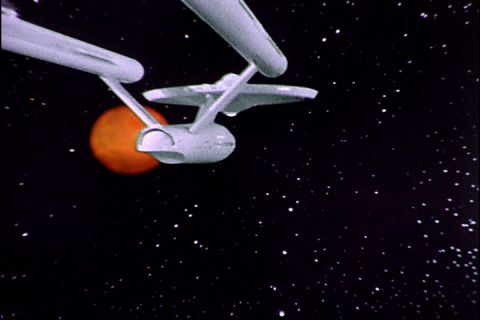
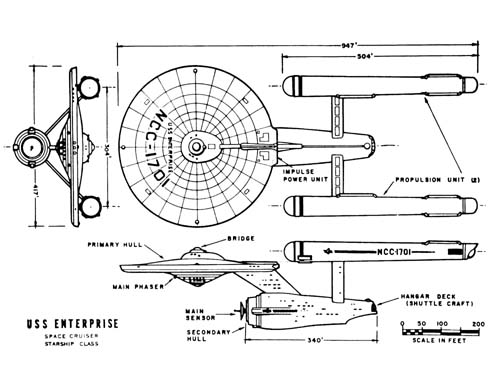
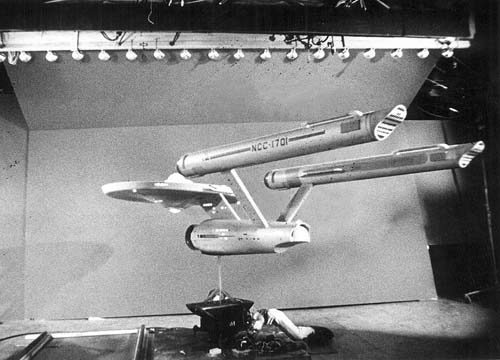
This is the original miniature of the U.S.S. Enterprise, used for optical effects shots in the first series of Star Trek (1966-1969). It’s been part of the Smithsonian collection since 1974, and has undergone several modifications in that time, including a new “mosaic” paint job to simulate square hull plating. (This concept, introduced with the starship’s redesign for Star Trek: The Motion Picture [Robert Wise, 1979], has since become standard for Trek’s vessels, reflected in the numerous sequels and series that constitute the franchise.)

After gazing reverently at the Enterprise for a while, I dragged my wife over to see it. I explained to her – feeling somewhat like a goofball – that this was not just a replica or facsimile, but the actual shooting model that went before the cameras of the Howard Anderson effects company, to which Desilu Studios farmed out its optical work. (Actually, the miniature made the rounds of several FX houses, including Film Effects of Hollywood, the Westheimer Company, and Van Der Veer Photo Effects – Trek demanding a particularly high number of expensive and time-consuming optical effects.) Eleven feet long and weighing 200 pounds, the miniature is made of poplar wood, vacuformed plastic, and sheet metal. It was one of three Enterprises used in shooting (the others included a small balsa-wood version that appeared in the “swish” flybys of the title sequence, and a three-foot version used to show the ship in the far distance). It was designed by Walter “Matt” Jefferies in consultation with series creator Gene Roddenberry, and build by Richard C. Datin, Jr.
Enterprise lofted

Enterprise in studio

The miniature undeniably has a sad aspect to it now. Consigned to what is essentially the museum basement, it sits by a shelf of books about Star Trek and Star Wars like an aging carny hawking its wares. Once lit from within by a complex electrical system of lights and relays, it is now shadowed and gloomy, its sepulchral air made more poignant by the racks of day-glow flags, posters, and coffee mugs that surround it. (In this, the back corner of the gift shop, the air-and-space motif gives way to a randomly-themed grab bag of DC memorabilia: Washington Monument t-shirts, Abraham Lincoln yo-yos.)

Yet despite or perhaps because of the diorama of motley neglect in which I encountered it, the Enterprise miniature possesses an historical solidity, a gravity classifying it as the best kind of museum exhibit: one that belongs simultaneously to past and present, functioning as a material bridge between one moment in time and another. For as I circled the plexiglass case, snapping pictures with my digital camera, I realized that the real magic was not in seeing the Enterprise with my own eyes. It was, instead, in the act of capturing its image — of being physically present at one node of a visual apparatus, framing the model in my viewfinder and recording the light rays reflecting off its surface. In doing so, I fleetingly occupied the position of the original camera operators at Howard Anderson and Van Der Veer in Hollywood in the late 1960s, whose daily job it was to line up and shoot this structure of wood and plastic.

Enterprise at NASM

Enterprise TV capture


Enterprise at NASM


Enterprise TV capture

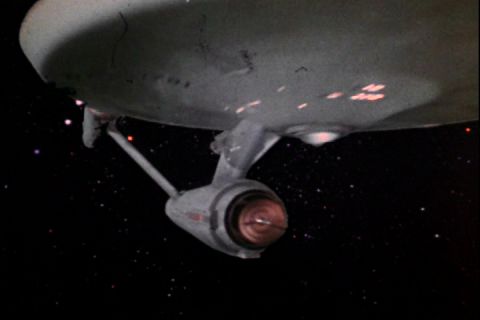
This, I suggest, is the real experience of the Enterprise. As a viewer growing up, watching the show on TV, I saw the starship only in its final composited form – as an “actual” vessel in space – experiencing a play-along immediacy that is the basic perceptual displacement necessary to the operation of television, movies, and videogames (we can only believe what we are seeing if we disbelieve in the fact of its having-been-made). Photographing the model at the National Air and Space Museum on Saturday, I experienced a flash of disbelief’s opposite, what I can only call mediacy, bringing layers of technology and labor – of historical material practice – back into the picture. It was like going to work and going to church at the same time, like punching a timeclock that is also a reliquary holding the bones of a saint. It was great; I’ll never forget it.
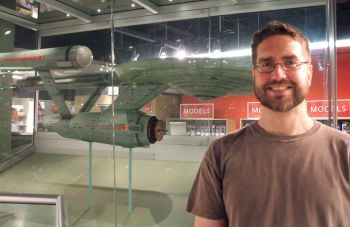
Bob at the NASM

Visualizing Harry Potter, Part 1

Recently, a couple of quotes caught my eye and got me thinking about the ongoing enterprise of visualizing Harry Potter – of taking J. K. Rowling’s seven-book series and translating, or to borrow Lev Manovich’s term, transcoding them into moving-image media like film and videogames. In this post I’ll explore some issues around the movie adaptations, centering on the use of special effects and visual effects to create Harry’s world of wizardry and magic. In part two, I’ll take the argument in a somewhat different direction, considering the impact of the movie versions on Rowling’s storytelling.

The first quote is from Roger Ebert’s review of Harry Potter and the Order of the Phoenix (David Yates, 2007). Although Ebert didn’t like Phoenix as much as some of the other installments in the series, he praises the film as a technical object, closing with a line that I found rather remarkable:

There is no denying that “Order of the Phoenix” is a well-crafted entry in the “Potter” series. The British have a way of keeping up production values in a series, even when the stories occasionally stumble. There have been lesser James Bond movies, but never a badly made one. And the necessary use of CGI here is justifiable, because what does magic create, anyway, other than real-life CGI without the computers?


The second quote is from Jason Mittell’s blog, and probably deserves a spoiler warning for those who haven’t yet finished Harry Potter and the Deathly Hallows. I’ve omitted a few details in order to keep from giving away too much:

DH features the best action scenes in the whole series, with a completely engaging and clear set of battles at the end, and what might be the best action sequence in the series, [SPOILER REDACTED]. At the end, I felt Rowling was issuing a challenge to Warner Bros. to see how much they’d be willing to invest in special effects to film the [MORE SPOILERS REDACTED] …


Here too, the last line speaks volumes (even with bits missing) about how special effects function nowadays – and more important, how they are imagined as functioning within a transmedia economy. Ebert suggests not just a metaphorical but an actual equivalence between that old saw “movie magic” and the “actual” marvels of magic that belong to Harry Potter’s storyworld. Certainly he views both as fictions – Hollywood trickery versus a writer’s fanciful imagination – but what comes through in his statement is something different: a new faith that visual effects, specifically computer-generated imagery or CGI, can bring the impossible into existence. By characterizing magic as “real-life CGI without the computers,” Ebert’s words do double ideological duty, simultaneously glamorizing and deglamorizing the “magic” of special effects. In the present day, he seems to be saying, CG artists possess a godlike power of creation. In the fantasy realm, meanwhile, witches and sorcerors can be considered “mere” technicians – skilled entertainers doing their job.


One could take Ebert’s words as signaling a collapse of reality into illusion, a conflation of the spectacular and the material a la Guy Debord’s Society of the Spectacle (1967). His comments could also be seen as redefining technology in such a way that its hardware (and by association the economic basis of its production and deployment) disappears from view; “CGI without the computers” suggests nothing so much as the joyously overblown rhetoric (and equally overblown vilification) of the virtual-reality (VR) movement in the 1990s. My take on it is slightly different. I think Ebert speaks, more or less unconsciously, from a moment in media evolution where the replication of fictional “worlds” across a variety of platforms – including videogames, in whose interactive arenas special effects become weighty matters of “life” and “death” – has granted those worlds an indeterminate status, weaving them into our daily reality. The world isn’t becoming “faker,” but stories, their events, and characters are becoming “realer.” CG effects are merely the most visible site of this realignment.


Mittell takes the argument about special effects in a different but related direction, speculating that the literary version of FX – fantastical events as described on the page – work in dialogue (and, he provocatively suggests, in tension) with media industries whose fortunes depend on successful realizations of those FX onscreen. Is Rowling really setting the bar higher, “issuing a challenge to Warner Brothers,” by writing such elaborate action sequences? (Trust me, Jason’s right on this: Deathly Hallows closes with some doozies, and frankly these pages left me as fatigued as the final hour of The Lord of the Rings: Return of the King [Peter Jackson, 2003].) Or is she in a kind of pas de deux with the visualization industry, steering her stories precisely to the kind of events that fill movie screens with thousands of characters in chaotic interaction?


The situation is difficult to gauge precisely because one now reads Harry Potter with the movies in mind, accompanying the print with at least sporadic visual associations distilled from the films’ contents. Many sequences in Deathly Hallows struck me as excessively cinematic, tilted toward some future storyboard: one minor instance comes early in the book, when characters encounter a roomful of colorful paper airplanes that are really interoffice memos in the Ministry of Magic. Maybe because I had just seen Order of the Phoenix, which memorably gives form to the Ministry and its darting airborne memos, the book’s scene immediately “read” in cinematic terms. But would I have had this sensation even without seeing any of the movies? Is it possible that Rowling is just that good, that descriptive, a writer?


I’m not saying any of this is a bad thing; indeed, I’m excited to witness the gigantic syncopated rhythms of a vastly profitable and popular media system that coordinates its printed and filmic incarnations with the grace of those balletic paper airplanes. But I do think we need to carefully dissect the processes involved in the transcoding – in the visualization – and suggest that special visual effects are a central place to begin the investigation.


Coming Up: In part two, I’ll talk about the cover art and chapter illustrations of Mary GrandPre, illustrator of the Harry Potter books, and consider how these images both set a visual agenda for the stories and mutate in step with the movies’ casting decisions and production design.

Movie-a-Day: June 2007

It’s been a fantastic summer so far. No classes to teach = lots of time to catch up on work and reading; my wife and I house-sat in Philadelphia for ten days, giving us a valuable but safely contained experience of life in the big city; like several of my colleagues, I finally bought a Wii.

But the most pleasurable and consciousness-expanding element of the summer has been my movie-a-day diet. Pure and simple, I committed to watching at least one film a day, beginning June 1. There are a few loose rules: ideally, the titles should be ones I haven’t seen before; they should be older movies (i.e. not currently playing in theaters); most important, they should be significant in some way, whether measured in terms of aesthetics, historical place, cultural impact, or position in one “canon” or another. As you’ll see from the list below, this leaves me a lot of selection variety, and one of the chief joys has been leaping from one cinematic universe to another, switching up classical Hollywood with European arthouse, chunky westerns with lithe anime, high art with low exploitation. I’ve struggled through some real endurance tests, but for the most part watching these movies has been a constantly rewarding experience, both personally and professionally (I’m getting lots of ideas for what to show my students in the fall).

Here’s the lineup for the first month. I’ve starred the films that made the greatest impression on me. I’ll continue to post these lists, and hazard some capsule reviews now and then.

Movie-a-Day: June 2007

The Getaway (Sam Peckinpah, 1972)
Stagecoach (John Ford, 1939)*
High Noon (Fred Zinnemann, 1952)*
The Man Who Shot Liberty Valance (John Ford, 1962)
The Man Who Fell to Earth (Nicolas Roeg, 1976)
Young Mister Lincoln (John Ford, 1939)*
From Russia with Love (Terence Young, 1963)
Princess Mononoke (Hayao Miyazaki, 1998)
A Place in the Sun (George Stevens, 1951)
Winchester ’73 (Anthony Mann, 1950)*
Fiend Without a Face (Arthur Crabtree, 1968)
Rebel Without a Cause (Nicholas Ray, 1955)*
Giant (George Stevens, 1956)
The Trouble with Harry (Alfred Hitchcock, 1955)
The Grapes of Wrath (John Ford, 1940)
Barbarella (Roger Vadim, 1968)
Halfouine: Child of the Terraces (Férid Boughedir, 1990)
The Pride of the Yankees (Sam Wood, 1942)
Seven Samurai (Akira Kurosawa, 1954)*
The Magnificent Seven (John Sturges, 1960)
Dodsworth (William Wyler, 1936)*
The Testament of Dr. Mabuse (Fritz Lang, 1933)*
Sherlock Jr. (Buster Keaton, 1924)
Grand Hotel (Edmund Goulding, 1932)
Orlando (Sally Potter, 1992)
To Have and Have Not (Howard Hawks, 1944)*
Mr. Death (Errol Morris, 1999)
Mutiny on the Bounty (Frank Lloyd, 1935)
Loves of A Blonde (Milos Forman, 1965)*
Norma Rae (Martin Ritt, 1979)